
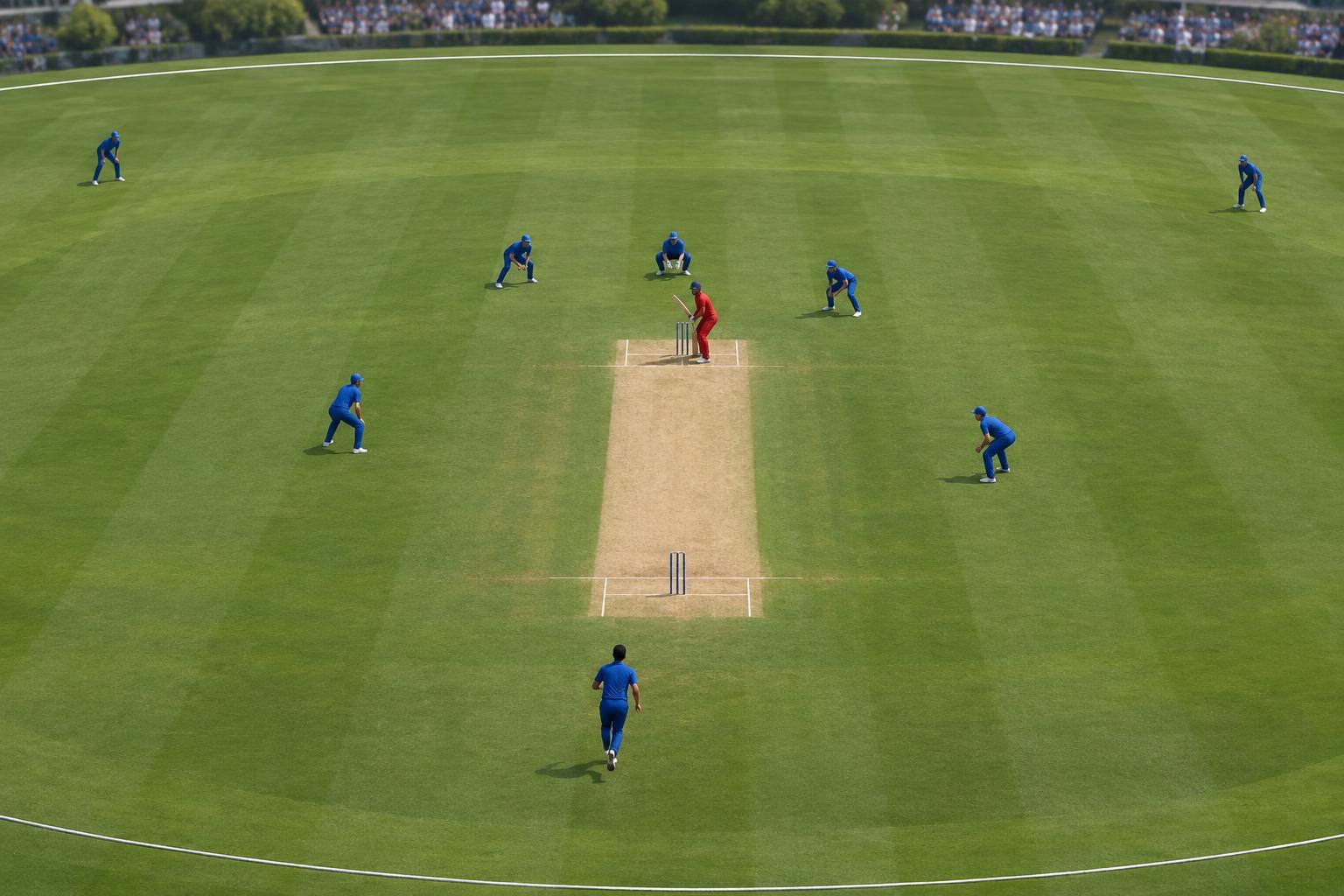
Cricket fielding positions explain more than where players stand: they reveal how a captain hopes to take a wicket or prevent runs. Understanding slip, gully, point, cover and midwicket makes commentary easier to follow—and helps you recognise the plan behind a delivery. Start with the batter, then work outwards by side, angle and distance.
Understanding the cricket field: off side and leg side
The pitch is the central strip between the wickets. At each end, the popping crease, often called the batting crease, runs across the pitch in front of the stumps. The boundary marks the outer edge of the playing area. Most fielding positions are named relative to the striker—the batter receiving the delivery—not the centre of the ground. (lords.org)
Imagine a line passing through both wickets and extending to the boundary. In a conventional sideways stance, the half facing the front of the batter’s body is the off side; the half behind their back is the leg side, also called the on side.
When a left-hander replaces a right-hander, those sides reverse. Cover remains an off-side position, but switches to the opposite physical side of the ground. (thegabba.com.au)
Square means approximately level with the striker’s crease. Backward means towards the wicket-keeper from that line; forward means towards the bowler.
Cricket fielding positions diagram
This original schematic uses a right-handed batter, with the bowler delivering upwards. The outer outline represents the boundary; the narrow central strip represents the pitch. Names indicate approximate areas, not compulsory standing spots. The positional relationships follow the conventional right-handed field map. (thegabba.com.au)
                       BEHIND THE BATTER
              .--------------------------------------.
            /                                          \
           /   Third man [B]          Fine leg [B]       \
          |                                              |
          |                Wicket-keeper                 |
          |      Slips [C]             Leg slip [C]      |
          |   Gully [C]                Leg gully [C]     |
          |                                              |
Deep      | Point [I]      BATTER       Square leg [I]   | Deep
point [B] |-----------------+----------------------------| square
          |    Silly point [C]  Short leg [C]            | leg [B]
          |                 | |                          |
          |   Silly mid-off [C] Silly mid-on [C]         |
          | Cover [I]       | |       Midwicket [I]      |
          |    Extra cover  | |                          |
          |        [I]      | |                          |
          |       Mid-off [I]  Mid-on [I]                |
           \                | |                         /
            \ Deep cover   BOWLER   Deep midwicket    /
             \    [B]                       [B]       /
              '----- Long off [B] -- Long on [B] -----'

                      OFF SIDE     LEG SIDE
                      TOWARDS THE BOWLER

[C] Close-catching area  [I] Infield area  [B] Boundary area
This is a reference map, not a single legal field setting. A full eleven includes the bowler and wicket-keeper, leaving nine other fielders. Captains select from these positions rather than occupying them all together. (lords.org)
Main fielding positions: names and roles
Close catchers
These fielders wait for chances that may travel only a short distance from the bat.
| Position | Location and purpose |
|---|---|
| Slip | Behind the striker on the off side, catching outside edges. First slip is nearest the keeper; further slips spread outwards. |
| Gully | Wider and squarer than slip, covering thicker edges and uppish square shots. |
| Leg slip | Behind the striker on the leg side, waiting for fine deflections or glances. |
| Leg gully | Wider and squarer than leg slip, catching leg-side deflections. |
| Short leg | Close on the leg side, usually in front of square, seeking bat-pad catches. |
| Silly point | Very close on the off side, around or just forward of square, catching edges and popped-up defensive strokes. |
| Silly mid-off and silly mid-on | Close, straighter catching positions towards the bowler, on the off and leg sides respectively. |
Close-in fielders have little reaction time. Appropriate protection—including a suitable helmet and abdominal guard where appropriate—is important, particularly at short leg and silly point.
The wicket-keeper stands behind the striker’s stumps, receiving deliveries and taking catches or stumpings.
Infield positions
Point, cover and midwicket are areas, not fixed distances. Their fielders can move closer or deeper to suit the plan.
| Position | Main job |
|---|---|
| Point | Approximately square on the off side, stopping cuts and square strokes. Backward point is slightly behind square. |
| Cover | In front of square on the off side, covering drives. Cover point lies between point and cover. |
| Extra cover | Between cover and mid-off, protecting straighter off-side drives. |
| Mid-off and mid-on | Towards the bowler on either side of the pitch, stopping drives and discouraging singles. |
| Midwicket | In front of square on the leg side, covering clips, flicks and pulls. |
| Square leg | Approximately level with the striker on the leg side, covering square strokes. |
Infielders also back up throws, create run-out opportunities and make batters hesitate over quick singles.
Boundary positions
Third man protects the off side behind square against edges and guided shots. Fine leg covers glances and deflections behind the batter on the leg side; deep fine leg specifies a position farther out. Long leg is usually squarer.
Deep point, deep cover, deep midwicket and deep square leg are outer versions of those areas. Long off and long on stand towards the boundary beyond mid-off and mid-on. Boundary fielders stop fours, but also catch lofted strokes.
How field-position terminology works
The extra word usually changes either distance or angle:
- Short: closer than usual, as in short cover.
- Silly: very close to the batter, as in silly point.
- Deep: farther from the batter, usually towards the boundary, as in deep midwicket.
- Fine: closer in angle to the pitch’s extended line; fine leg is less square than square leg.
- Wide: farther sideways from that line, as in wide mid-off.
- Long: used in established names such as long off and long on for positions beyond mid-off and mid-on.
Attacking and defensive cricket field setups
An attacking field prioritises likely wicket-taking chances; a defensive field gives greater weight to restricting scoring. Neither works well unless it supports the bowler’s line and length.
Against pace, slips and gully target outside edges. An illustrative attacking setup could use two slips, gully, point, cover, mid-off, mid-on, square leg and fine leg. That uses all nine available fielders, but leaves much of the boundary unprotected.
Against spin, slip, short leg and silly point may threaten catches from edges or bat-pad deflections. Turn, bounce and the batter’s technique determine which close catchers are useful: a ball turning away presents different chances from one turning into the pads.
A defensive adjustment might move cover to deep cover and mid-on to long on. The captain gains boundary protection but may concede easier singles. A deep fielder is not automatically defensive, however: that player may be waiting specifically for a lofted shot.
Fielding restrictions and powerplays
At the instant of delivery, no more than two fielders, excluding the wicket-keeper, may be behind the popping crease on the leg side. This is a general restriction under the Laws, not simply a powerplay rule. (lords.org)
Limited-overs cricket adds restrictions on how many fielders may stand outside the marked fielding area, including during powerplays. The permitted numbers and phases depend on the format and competition’s playing conditions; one set of limits should not be applied to every match. (images.icc-cricket.com)
For the wider framework, see our guide to cricket’s laws and rules.
Frequently asked questions
What are the main fielding positions in cricket?
The main names include wicket-keeper, slip, gully, point, cover, extra cover, mid-off, mid-on, midwicket, square leg, fine leg and third man. Short, silly and deep variations describe different distances.
What is the difference between off side and leg side?
In a conventional batting stance, the off side faces the front of the batter’s body; the leg side is behind their back. Neither is permanently the left or right half of a television picture.
Where do slip, gully, point and cover stand?
All are off-side positions. Moving from behind the batter towards the bowler, the sequence is broadly slip, gully, point and cover: point is approximately square, while cover is forward of square.
Why do captains change cricket fielding positions?
To support a bowling plan, counter a batter’s preferred shots or respond to the required scoring rate. A change may target a catch, close a gap or deliberately offer a single.
Do fielding positions change for left-handed batters?
Yes. The off and leg sides reverse, so the positions switch sides while keeping their names. Captains may also change the tactics rather than simply mirror the previous field.