
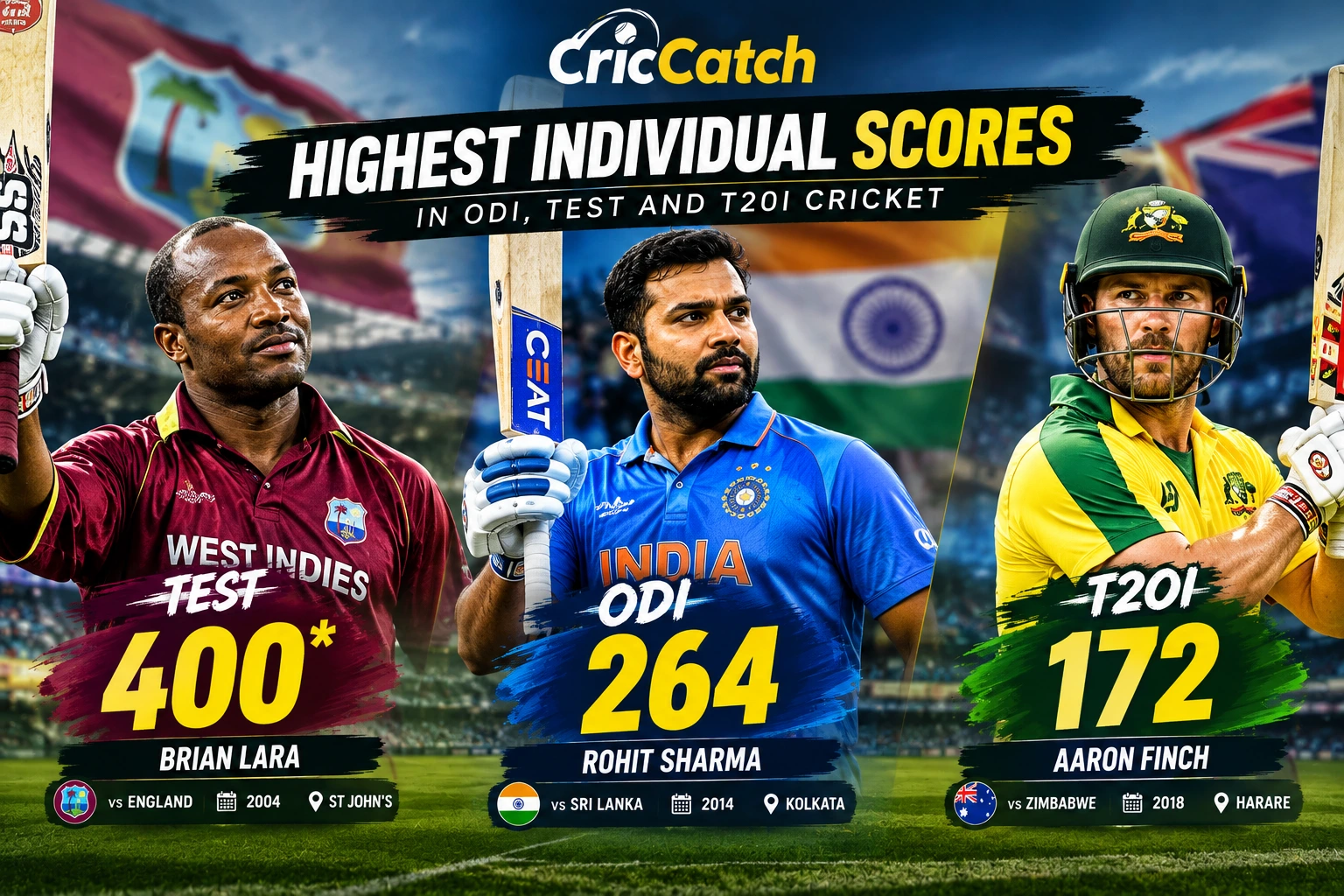
Highest Individual Scores in ODI, Test and T20I Cricket
Cricket has produced some huge individual batting performances, but the biggest score depends on the format. A Test batter can stay at the crease for a very long time, an ODI batter has 50 overs to build a huge innings, while a T20I batter has only 20 overs to make an impact.
In men international cricket, Brian Lara holds the highest individual Test score with 400 not out, Rohit Sharma holds the ODI record with 264, and Aaron Finch still owns the highest T20I score with 172. These records were created in very different conditions and with very different batting styles.
| Format | Highest Score | Batter | Opposition | Year |
|---|---|---|---|---|
| Test | 400* | Brian Lara | England | 2004 |
| ODI | 264 | Rohit Sharma | Sri Lanka | 2014 |
| T20I | 172 | Aaron Finch | Zimbabwe | 2018 |
The interesting part is that none of these records is simply about hitting boundaries. Lara had to bat for 582 balls, Rohit faced 173 balls, while Finch scored his 172 from only 76 deliveries. That difference tells us how dramatically batting changes from one format to another.
Highest Individual Score in Test Cricket: Brian Lara’s 400* Record
Brian Lara's 400 not out remains the highest individual score in men's Test cricket. He made it for West Indies against England at St John's, Antigua, in 2004. The innings came ten years after Lara had first taken the Test record with 375, making him the only player to break the highest-score record twice.
Lara's 400* was not a short burst of boundary hitting. It was a long Test innings that lasted 582 balls and included 43 fours and four sixes. He reached 100 from 131 balls and had faced 404 deliveries by the time he reached 300. This shows the patience, concentration and physical effort needed to produce an innings of this size.
Brian Lara’s 400* Against England and How the Innings Developed
Lara entered the 2004 Test knowing that Matthew Hayden had taken his previous record by scoring 380 against Zimbabwe. Lara then returned to the top in one of the greatest individual performances in Test history. He passed Hayden's 380 and continued until reaching the first 400 in Test cricket.
What makes the innings special is the way Lara combined control with attacking strokes. He was not simply defending for days. He kept scoring, found boundaries regularly and stayed at the crease long enough to push the record far beyond 350. Even in modern cricket, where batting has become more aggressive, 400 in a Test innings remains a huge challenge.
Top Test Individual Scores Behind Lara’s 400* Record
Lara's record sits at the top of a very small group of Test innings above 350. Matthew Hayden came close with 380, while Lara himself appears again with 375. Mahela Jayawardena scored 374, and Wiaan Mulder's unbeaten 367 in 2025 moved into fifth place on the all-time list.
| Rank | Batter | Score | Opposition | Year |
|---|---|---|---|---|
| 1 | Brian Lara | 400* | England | 2004 |
| 2 | Matthew Hayden | 380 | Zimbabwe | 2003 |
| 3 | Brian Lara | 375 | England | 1994 |
| 4 | Mahela Jayawardena | 374 | South Africa | 2006 |
| 5 | Wiaan Mulder | 367* | Zimbabwe | 2025 |
| 6 | Garfield Sobers | 365* | Pakistan | 1958 |
| 7 | Leonard Hutton | 364 | Australia | 1938 |
| 8 | Sanath Jayasuriya | 340 | India | 1997 |
| 9 | Hanif Mohammad | 337 | West Indies | 1958 |
| 10 | Wally Hammond | 336* | New Zealand | 1933 |
One of the most interesting recent stories came in 2025, when South Africa's Wiaan Mulder reached 367* against Zimbabwe. He was only 34 runs away from Lara's record but South Africa declared at 626/5. As a result, Lara's 400* remained at the top.
Highest Individual Score in ODI Cricket: Rohit Sharma’s 264
Rohit Sharma's 264 against Sri Lanka remains the highest individual score in men's ODI cricket. He made the record at Eden Gardens in Kolkata on 13 November 2014, scoring 264 from 173 balls.
The innings contained 33 fours and nine sixes, giving Rohit a remarkable boundary count. He became the first batter to score two ODI double-centuries during that innings, and he later added a third double-century to his career. Rohit remains the only batter with three ODI scores of 200 or more.
How Rohit Sharma Reached the Record 264 in ODI Cricket
Rohit's innings is a great example of how an ODI batter can change gears. He did not need to hit every ball from the beginning. Instead, he built the innings, reached a century and then became increasingly aggressive as the innings moved towards the final overs.
His 264 came off 173 balls, which means he maintained a strike rate of more than 150 while also batting deep into the innings. He was dismissed from the final ball of India's innings, showing just how much of the 50-over opportunity he used.
The record also came after Rohit had already missed time through injury, making the performance even more memorable. His ability to turn a long ODI innings into an extremely high scoring performance is one reason his 264 has remained untouched for more than a decade.
Top 10 Highest Individual Scores in Men’s ODI Cricket
The ODI record list has changed since Rohit made 264. Shubman Gill's 223* and Pathum Nissanka's 210* are now among the biggest ODI innings, while Ishan Kishan, Fakhar Zaman and Virender Sehwag have also crossed 210.
| Rank | Batter | Score | Opposition | Year |
|---|---|---|---|---|
| 1 | Rohit Sharma | 264 | Sri Lanka | 2014 |
| 2 | Martin Guptill | 237* | West Indies | 2015 |
| 3 | Shubman Gill | 223* | New Zealand | 2023 |
| 4 | Virender Sehwag | 219 | West Indies | 2011 |
| 5 | Chris Gayle | 215 | Zimbabwe | 2015 |
| 6 | Fakhar Zaman | 210* | Zimbabwe | 2018 |
| 7 | Pathum Nissanka | 210* | Afghanistan | 2024 |
| 8 | Ishan Kishan | 210 | Bangladesh | 2022 |
| 9 | Rohit Sharma | 209 | Australia | 2013 |
| 10 | Rohit Sharma | 208* | Sri Lanka | 2017 |
The list shows something very interesting about modern ODI batting. Double-centuries were once almost impossible, but they have become more common as batting conditions, equipment, fitness and attacking methods have improved.
Even so, Rohit's 264 remains a long way ahead of the next score. The gap between 264 and Guptill's 237* is 27 runs, which shows just how far Rohit pushed the ODI scoring limit.
Highest Individual Score in T20I Cricket and Record-Breaking Batting
The current men's T20I record belongs to Australia's Aaron Finch, who scored 172 against Zimbabwe in Harare in 2018. He made the score from 76 balls with 16 fours and 10 sixes.
The record is especially impressive because T20I innings last only 20 overs. Finch scored more than 170 runs in an innings where his team could face only 120 legal deliveries. His performance helped Australia reach 229/2 and win the match by 100 runs.
Who Has Scored the Highest Individual Score in T20I Cricket?
Aaron Finch's 172 remains the men's T20I record as of October 2026. The record has survived since 2018, even though several batters have come close.
The latest major challenge came in May 2026, when Rwanda's Hamza Khan scored 164* against Ivory Coast. His innings came from only 65 balls and included nine fours and 15 sixes. That moved him into second place on the men's T20I all-time list.
How the T20I Highest Score Record Has Changed Over Time
The T20I record has grown rapidly as the format has developed. Aaron Finch first set the record with 156 against England in 2013. Five years later, he returned to the top with 172 against Zimbabwe.
The progression shows how quickly T20 batting has changed. Players now use the powerplay more aggressively, target different areas of the ground and take greater risks against both pace and spin. Yet Finch's 172 remains the benchmark because it combined a huge score with an extremely high scoring rate.
| Rank | Batter | Score | Balls | Opposition | Year |
|---|---|---|---|---|---|
| 1 | Aaron Finch | 172 | 76 | Zimbabwe | 2018 |
| 2 | Hamza Khan | 164* | 65 | Ivory Coast | 2026 |
| 3 | Hazratullah Zazai | 162* | — | Ireland | 2019 |
| 4 | Mohammad Ihsan | 160 | — | Croatia | 2025 |
| 5 | Aaron Finch | 156 | 63 | England | 2013 |
| 6 | Glenn Maxwell | 145* | 65 | Sri Lanka | 2016 |
| 7 | Evin Lewis | 125* | 62 | India | 2017 |
| 8 | Shane Watson | 124* | 71 | India | 2016 |
| 9 | Babar Azam | 122* | — | South Africa | 2021 |
| 10 | Chris Gayle | 117* | — | England | 2009 |
The current record list also highlights an important point: T20I cricket now includes a much wider group of international teams. Hamza Khan's 164* for Rwanda shows that record-breaking T20 batting is no longer limited to the traditional major cricket nations.
Top 10 Highest Individual Scores Across ODI, Test and T20I Cricket
It is tempting to put every format into one ranking and call the biggest number the greatest innings. But that would not be a fair comparison. A Test batter can face hundreds of balls, while a T20I batter may have only a few dozen deliveries.
For that reason, the better way to compare these records is to understand their format. Lara's 400* represents extreme endurance, Rohit's 264 represents extraordinary ODI volume and Finch's 172 represents extreme T20 scoring speed.
Biggest Test Innings by Individual Batters in Cricket History
Test cricket has produced the biggest raw individual scores because an innings can continue for days. The top of the list is dominated by players who combined concentration with the ability to score boundaries when opportunities appeared.
| Rank | Batter | Score | Opposition | Year |
|---|---|---|---|---|
| 1 | Brian Lara | 400* | England | 2004 |
| 2 | Matthew Hayden | 380 | Zimbabwe | 2003 |
| 3 | Brian Lara | 375 | England | 1994 |
| 4 | Mahela Jayawardena | 374 | South Africa | 2006 |
| 5 | Wiaan Mulder | 367* | Zimbabwe | 2025 |
These scores are rare because a batter must survive for a very long period. A single mistake can end an innings at any point, while fatigue and changes in pitch conditions can make batting harder as the match progresses.
Biggest ODI and T20I Innings by Individual Batters
ODI and T20I cricket reward a different type of batting. Rohit Sharma's 264 came from 173 balls, while Finch's 172 came from only 76 balls. The numbers show why the two records should not be judged only by total runs.
ODI cricket allows a batter to build a huge innings over 50 overs, while T20I cricket forces the batter to score quickly. Hamza Khan's 164* in 65 balls is a good modern example of how quickly a T20I record innings can develop.
Highest Individual Scores by Format and What Makes Them Different
The first thing a young cricket fan should understand is that a high score has different meanings in different formats. A 100 in Test cricket can be a very long and difficult innings, while a 100 in T20I cricket is often built through a much higher strike rate.
This is why comparing Lara's 400*, Rohit's 264 and Finch's 172 only by the number of runs misses the main story. Each player had a different amount of time, a different match structure and a different level of risk.
Why 400 in Tests Is Different From 264 in ODIs
A Test innings has no fixed number of overs for the batting team. A batter can continue as long as they are not dismissed and their team does not declare. That creates the possibility of enormous scores such as Lara's 400*.
ODI cricket gives each team a maximum of 50 overs. This creates a clear time limit. Rohit therefore had to balance survival and attack while knowing that India's innings would end after 50 overs. His 264 came from 173 balls, showing how much scoring pressure he maintained.
Why a Huge T20I Score Needs a Completely Different Batting Approach
T20I cricket gives a team only 120 legal balls if it bats for the full 20 overs. This means a batter cannot spend too long simply building an innings.
Finch's 172 from 76 balls shows the difference. He scored 16 fours and 10 sixes and helped Australia reach 229/2. Hamza Khan's 164* from 65 balls in 2026 provides another example of the extreme scoring rate possible in the shortest international format.
Fastest Route to the Highest Individual Scores in Each Format
A record score is not only about the final number. Fans also want to know how quickly the batter reached it, how many boundaries were involved and whether the innings was based on power or long concentration.
That makes balls faced, boundaries and strike rate useful when studying these records. They help explain the story behind the number rather than treating the score as an isolated statistic.
Balls, Boundaries and Strike Rate Behind Record-Breaking Innings
| Record | Score | Balls | Fours | Sixes | Approx. Strike Rate |
|---|---|---|---|---|---|
| Brian Lara, Test | 400* | 582 | 43 | 4 | 68.73 |
| Rohit Sharma, ODI | 264 | 173 | 33 | 9 | 152.60 |
| Aaron Finch, T20I | 172 | 76 | 16 | 10 | 226.31 |
| Hamza Khan, T20I | 164* | 65 | 9 | 15 | 252.30 |
Lara's innings shows endurance, Rohit's shows sustained ODI aggression and Finch's shows explosive T20 scoring. Hamza's 164* is even faster by strike rate, but Finch's final score remains higher.
Which Record Innings Were Built on Power and Which on Long Batting?
Lara's 400* clearly belongs to the long-batting category. He faced 582 balls and stayed unbeaten, which required concentration over a huge period of time.
Rohit and Finch show a different balance. Both scored at very high rates while also batting deep into their team's innings. Finch's 172 is particularly extreme because he reached 100 from only 50 balls and continued attacking until he was dismissed late in the innings.
Players With Multiple Record-Breaking Individual Scores
Some batters do not produce one giant innings by chance. Their careers show repeated ability to score at extraordinary levels. Rohit Sharma is the clearest ODI example because he has three double-centuries.
Brian Lara also has a special place in Test record history. He first took the Test record with 375 in 1994, lost it to Matthew Hayden in 2003, and then took it back with 400* in 2004.
Rohit Sharma’s Multiple ODI Double-Century Records
Rohit's three ODI double-centuries are 209 against Australia, 264 against Sri Lanka and 208 against Sri Lanka*. No other men's ODI batter has reached 200 three times.
| Score | Opposition | Year |
|---|---|---|
| 209 | Australia | 2013 |
| 264 | Sri Lanka | 2014 |
| 208* | Sri Lanka | 2017 |
This is why Rohit's record is more than just the number 264. His repeated 200-plus performances show a special ability to keep scoring after reaching the point where most batters would already have a career-best score.
Other Batters Who Have Produced Multiple Huge International Scores
Brian Lara is another strong example. His 375 and 400* are both among the top four Test scores in history. He is the only player to have broken the highest individual Test-score record twice.
Aaron Finch also owns two of the top five men's T20I scores: his record 172 and his previous record 156. The two innings came five years apart, showing that his T20 batting was not based on one isolated performance.
Highest Individual Scores by Indian, Australian, Pakistani and Other Batters
Record lists also become more interesting when viewed country by country. India, Australia, Pakistan, Sri Lanka, West Indies and other nations have all produced batters capable of creating huge individual scores.
This country angle helps fans understand where major batting records have come from. It also shows that the growth of limited-overs cricket has spread high-scoring performances across more teams.
Highest Individual Scores by Major Cricket Nations
| Country | Notable Highest Score | Batter | Format |
|---|---|---|---|
| West Indies | 400* | Brian Lara | Test |
| Australia | 380 | Matthew Hayden | Test |
| India | 264 | Rohit Sharma | ODI |
| New Zealand | 237* | Martin Guptill | ODI |
| Pakistan | 210* | Fakhar Zaman | ODI |
| Sri Lanka | 374 | Mahela Jayawardena | Test |
| Afghanistan | 162* | Hazratullah Zazai | T20I |
| Rwanda | 164* | Hamza Khan | T20I |
These examples should not be treated as one universal ranking because they come from different formats. They are better used to show how different countries have produced record-level individual batting performances.
Which Countries Have Produced the Most Record-Breaking Innings?
Traditional cricket nations have naturally produced many of the biggest scores because they have played international cricket for longer and have more matches in the major formats.
However, T20I cricket is changing that picture. Hamza Khan's 164* for Rwanda in 2026 is a strong example. His innings moved into second place in the men's T20I record list, showing that major batting records are becoming more global.
Highest Individual Scores in World Cup, Test and T20I Major Events
Overall international records are not the only numbers fans search for. Tournament records can be even more interesting because they are produced under high pressure and against strong international opposition.
For example, Martin Guptill's 237* against West Indies remains the highest individual score in men's Cricket World Cup history. It came in the 2015 quarter-final and helped New Zealand move into the semi-finals.
Highest Individual Scores in ODI World Cup Cricket
The World Cup has produced several famous innings, but Guptill's 237* remains the tournament benchmark. Rohit's 264 is higher than Guptill's score, but it was not a World Cup innings, which is why it does not replace Guptill on the World Cup-specific record list.
This is an important distinction for readers: overall ODI record and ODI World Cup record are different categories. Mixing them can create confusion.
Highest Individual Scores in T20 World Cup Cricket
T20 World Cup records also need to be kept separate from overall T20I records. A player can hold the overall T20I record without holding the T20 World Cup record.
The 2026 T20 World Cup showed how quickly scoring standards are rising. India scored 255/5 against New Zealand in the final, the highest total in a T20 World Cup final and the highest score in a T20I knockout or playoff match at that time.
Highest Individual Scores by Active International Cricket Batters
Record articles often focus heavily on retired legends, but readers also want to know which current players are capable of producing the next huge innings.
That question has become especially interesting in 2026. ODI cricket still has players such as Rohit Sharma and Shubman Gill producing major scores, while T20I cricket has a new generation of aggressive batters. Rohit remains particularly relevant because he is still active in ODIs and recently crossed 12,000 ODI runs in September 2026.
Which Active Batters Are Closest to the Major International Records?
In ODI cricket, Rohit himself remains the record holder, while Shubman Gill has already entered the top three with 223*. Gill's score came against New Zealand in 2023 and is currently the third-highest men's ODI score.
In T20I cricket, current high-level batters include players from several countries. But the gap to Finch's 172 remains significant. The arrival of players such as Hamza Khan at 164* shows that the record is under pressure, although it still requires an exceptional innings to be broken.
Which Current Batters Could Challenge the Existing Records?
It is impossible to predict exactly who will break a world record. A player needs the right pitch, enough balls, strong fitness, good conditions and an opposition attack that can be pressured for a long period.
What we can say is that modern batting is producing more high scores. In T20 cricket, players are comfortable taking risks from the first over, while ODI batters are increasingly capable of converting centuries into 150s, 200s and beyond.
Can Brian Lara’s 400 and Rohit Sharma’s 264 Records Be Broken?
The short answer is yes, but both will be extremely difficult to beat.
Lara's 400* survived a major challenge from Wiaan Mulder in 2025. Mulder reached 367* and had a realistic chance to move closer to Lara's mark, but South Africa declared and left the record untouched.
Rohit's 264 also faces an interesting future. ODI batting has become more aggressive, and players now have better fitness, equipment and scoring methods. Shubman Gill's 223* shows that 200-plus scores are still possible, but moving from 223 to 264 requires another 41 runs on an already huge score.
Why Modern Batting Could Produce Even Bigger Individual Scores
Modern batters understand scoring rates better than ever. They use different shots for different areas, target specific bowlers and are physically prepared to maintain a high scoring rate.
ODI rules and batting conditions can also create opportunities for huge totals. If a batter survives the new-ball period and has enough wickets around them, a 50-over innings can become very large.
T20 cricket has gone even further. The rise of power hitting means scores that once looked impossible are now regularly approached. Hamza Khan's 164* in 2026 is another example of how quickly the ceiling can move.
What Makes These Records Extremely Hard to Beat
The biggest problem is not simply scoring runs. It is staying at the crease long enough to score them.
For Lara, that meant surviving 582 balls. For Rohit, it meant facing 173 balls in an ODI and continuing to attack. For Finch, it meant maintaining an extraordinary T20 scoring rate over 76 balls. One mistake, injury, change in conditions or tactical bowling plan can end a record attempt immediately.
Biggest Individual Scores That Changed Cricket Record History
Cricket's record book has not stayed the same. As batting methods changed, players repeatedly pushed the highest individual score higher.
In ODI cricket, the record moved from John Edrich's 82 in the first ODI to Dennis Amiss's 103, then through scores such as 171, 183, 189 and 194 before Sachin Tendulkar became the first batter to reach 200. Virender Sehwag then moved the record to 219 before Rohit Sharma raised it dramatically to 264.
From the First ODI Double Century to Modern 200-Plus Scores
Sachin Tendulkar became the first men's ODI batter to score 200 when he made 200* against South Africa in 2010. Sehwag then scored 219 in 2011, and Rohit later took the record to 264.
The progression shows how quickly ODI batting changed. Once a double century looked almost impossible, it became a target that several elite batters could reach.
How Batting Records Have Expanded Across Cricket Formats
Test cricket created the biggest raw numbers because of its longer structure. ODI cricket then created a new challenge by putting a 50-over limit on scoring. T20 cricket went even further by forcing batters to score quickly within only 20 overs.
That means each format has created its own type of record. Lara's 400* is about extreme endurance, Rohit's 264 about sustained limited-overs dominance, and Finch's 172 about explosive scoring.
ODI, Test and T20I Highest Scores: Complete Record Comparison
After looking at the individual stories, the easiest way to remember the main records is to put them side by side.
This comparison also makes the format differences clear. Lara's 400* is the largest number, Rohit's 264 is the highest ODI score, and Finch's 172 remains the highest T20I score.
Complete Men’s International Individual Score Record Table
| Format | Record Score | Batter | Opposition | Venue | Year |
|---|---|---|---|---|---|
| Test | 400* | Brian Lara | England | St John's, Antigua | 2004 |
| ODI | 264 | Rohit Sharma | Sri Lanka | Kolkata, India | 2014 |
| T20I | 172 | Aaron Finch | Zimbabwe | Harare, Zimbabwe | 2018 |
These three numbers are the main records a cricket fan should remember. Lara's 400* has remained the Test benchmark since 2004, Rohit's 264 has remained the ODI benchmark since 2014, and Finch's 172 has remained the T20I benchmark since 2018.
Key Facts Every Cricket Fan Should Know About These Records
- Brian Lara — 400*: Highest individual score in men's Test cricket.
- Rohit Sharma — 264: Highest individual score in men's ODI cricket.
- Aaron Finch — 172: Highest individual score in men's T20I cricket.
- Hamza Khan — 164*: Second-highest men's T20I score as of 2026.
- Rohit Sharma is the only men's ODI batter with three double-centuries.
- Brian Lara is the only player to have broken the Test individual-score record twice.
- Shubman Gill — 223* is currently the third-highest men's ODI score.
- Wiaan Mulder — 367* is the fifth-highest men's Test score.
Final Verdict on the Highest Individual Score Records
The answer depends on the format. Brian Lara holds the highest Test score with 400, Rohit Sharma holds the highest ODI score with 264, and Aaron Finch holds the highest T20I score with 172.* These are three different records built through three very different styles of batting.
Lara's record is a story of patience and extreme endurance. Rohit's 264 is a story of ODI power combined with the ability to bat deep into a 50-over innings. Finch's 172 is a story of pure T20 aggression, while Hamza Khan's 164* in 2026 shows that the modern T20I record is still under pressure.
For young cricket fans, the biggest lesson is simple: a huge score is not just about hitting the most boundaries. It is about understanding the format, staying at the crease, choosing the right time to attack and making the most of every ball. That is what makes the greatest individual scores in international cricket so special.
**