
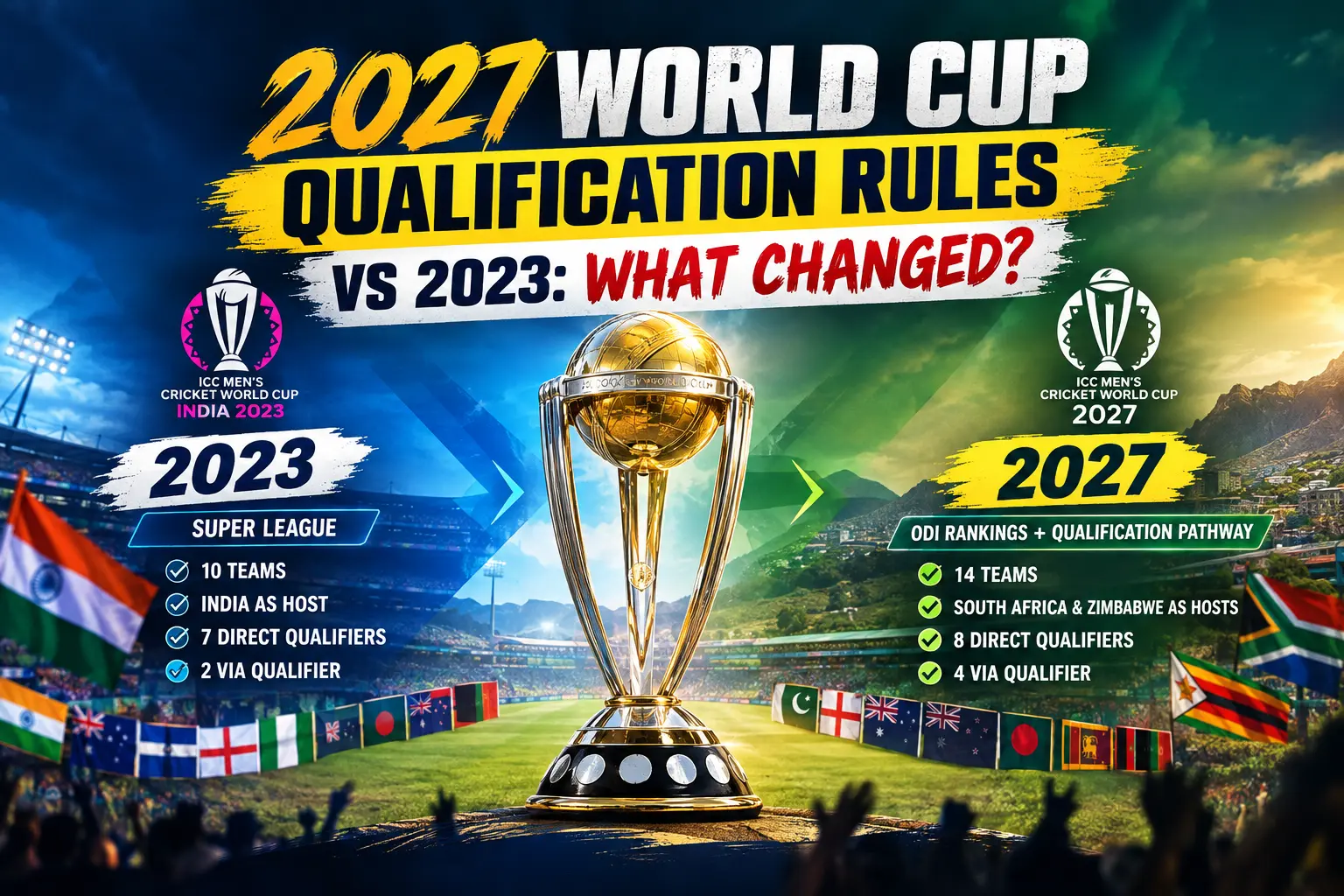
2027 World Cup Qualification Rules vs 2023: What Changed?
The qualification system for the 2027 Cricket World Cup is quite different from the one used for the 2023 edition. In 2023, India qualified automatically as the host, while the next seven teams from the ICC Cricket World Cup Super League earned direct places. The remaining two spots were decided through the 2023 World Cup Qualifier, which included five teams from the Super League and five Associate nations.
For 2027, the World Cup has expanded from 10 to 14 teams, and the qualification pathway has been changed. South Africa and Zimbabwe receive automatic places as Full Member hosts, while the next eight highest-ranked teams in the ODI rankings are set to qualify directly. The remaining four places will come through the World Cup Qualifier, with teams reaching that stage through the wider qualification pathway, including League 2 and the Qualifier Play-off. The biggest change, therefore, is that 2023 depended heavily on the Super League, while 2027 puts much more focus on ODI rankings and a broader qualification pathway.
What Were the 2023 World Cup Qualification Rules?
For the 2023 Cricket World Cup, the main qualification route was the ICC Cricket World Cup Super League, which involved 13 teams and ran from 2020 to 2023. India qualified automatically as the host, while the next seven teams in the Super League standings earned direct places in the 10-team World Cup. Each team played 24 Super League matches, with 10 points for a win, 5 for a tie or no result, and 0 for a loss.
Qualification Route 2023 Rule
Host Nation India automatically qualified as the host
Super League 13 teams competed for direct qualification
Direct Qualification India ke ilawa Super League ki top 7 teams qualified
Remaining Spots 2 places World Cup Qualifier se decide hui
World Cup Qualifier 10 teams ne final 2 places ke liye compete kiya
League 2 Teams League 2 ki top 3 teams Qualifier mein pahunchi
Qualifier Play-off Play-off ki top 2 teams Qualifier mein pahunchi
Final Qualification Qualifier ki top 2 teams ne 2023 World Cup ke liye qualify kiya
The remaining two World Cup places were decided through the 2023 Cricket World Cup Qualifier. The five teams that finished outside the direct qualification places in the Super League joined the top three teams from League 2 and the top two teams from the Qualifier Play-off. These 10 teams competed for the final two spots, with the top two teams from the Qualifier advancing to the World Cup in India.
What Are the 2027 World Cup Qualification Rules?
The 2027 Cricket World Cup qualification system is built around 14 teams. South Africa and Zimbabwe qualify automatically as Full Member hosts, while the next eight highest-ranked teams in the ICC ODI rankings earn direct qualification. The remaining four places are decided through the World Cup Qualifier, giving teams outside the direct qualification places another route to the tournament.
| Qualification Route | 2027 Rule |
|---|---|
| Total Teams | 14 teams |
| Automatic Hosts | South Africa and Zimbabwe |
| Direct ODI Ranking Spots | Next 8 highest-ranked ODI teams |
| Direct Qualifiers in Total | 10 teams |
| Remaining Spots | 4 places through the World Cup Qualifier |
| League 2 Route | Top 4 teams advance to the World Cup Qualifier |
| Qualifier Play-off Route | 4 teams advance to the World Cup Qualifier |
| Final Qualifier | Top 4 teams qualify for the World Cup |
| Namibia | Co-host, but not automatically qualified |
The important change is that 2027 qualification relies much more on ODI rankings and a wider qualification pathway. The top four teams from League 2 and four teams from the Qualifier Play-off can reach the World Cup Qualifier, where the top four earn World Cup places. Namibia is also a co-host, but unlike South Africa and Zimbabwe, it does not receive automatic qualification.
2027 vs 2023 World Cup Qualification Rules: What Changed?
Biggest change is that the 2027 World Cup has moved away from the 2023 Super League-based qualification system. For 2023, India qualified automatically as host, while the other seven direct places went to the highest-ranked teams in the Cricket World Cup Super League. The remaining two places were decided through a 10-team Qualifier.
For 2027, the World Cup has expanded from 10 to 14 teams, with South Africa and Zimbabwe receiving automatic places as Full Member hosts. The next eight teams in the ODI rankings are set to qualify directly, while the remaining four places will be decided through the new qualification pathway. This means ODI ranking position has a much more direct role in 2027, while the Super League is no longer the main qualification competition.
| Qualification Factor | 2023 World Cup | 2027 World Cup |
|---|---|---|
| Number of teams | 10 | 14 |
| Host qualification | India qualified automatically | South Africa and Zimbabwe qualify automatically |
| Main direct route | Super League standings | ODI rankings |
| Direct qualification | Host + 7 Super League teams | 2 hosts + 8 highest-ranked ODI teams |
| Main qualification league | Cricket World Cup Super League | No Super League for this cycle |
| Remaining places | 2 | 4 |
| Final qualifier | 10-team World Cup Qualifier | World Cup Qualifier through the new pathway |
| Associate pathway | League 2 and Qualifier Play-off | League 2 and Qualifier Play-off continue as part of the pathway |
So, in simple terms, 2023 was mainly about finishing high in the Super League, while 2027 puts greater emphasis on a team's ODI ranking and provides four World Cup places through the wider qualification pathway. The increase from 10 to 14 teams also gives more countries a route into the World Cup.
How Many Teams Qualify Directly in 2027 vs 2023?
The number of teams qualifying directly has increased because the 2027 World Cup will have 14 teams instead of 10 in 2023. In 2023, India qualified automatically as host and the next seven teams from the Super League earned direct places, giving eight direct qualifiers in total. For 2027, South Africa and Zimbabwe receive automatic places as Full Member hosts, while the next eight teams in the ODI rankings qualify directly, giving 10 direct qualifiers.
| Qualification | 2023 World Cup | 2027 World Cup |
|---|---|---|
| Total World Cup teams | 10 | 14 |
| Automatic host places | 1 | 2 |
| Direct qualification through main ranking/competition route | 7 | 8 |
| Total direct qualifiers | 8 | 10 |
| Places decided through Qualifier | 2 | 4 |
So, the simple difference is that 2023 had 8 direct qualifiers, while 2027 will have 10. This gives teams a wider route into the tournament, with only four places left to be decided through the 2027 qualification pathway.
How Did Host Qualification Change From 2023 to 2027?
In the 2023 World Cup, India received an automatic place because it was the sole host. The other seven direct places were decided through the Cricket World Cup Super League, so hosting the tournament gave India a guaranteed place regardless of its Super League position.
For the 2027 World Cup, the situation is different because the tournament has three co-hosts. South Africa and Zimbabwe qualify automatically as Full Member hosts, while Namibia does not receive an automatic place and must qualify through the regular qualification pathway. This makes the 2027 system different from 2023, where the host country alone had the automatic spot.
| Host Qualification | 2023 World Cup | 2027 World Cup |
|---|---|---|
| Host countries | India | South Africa, Zimbabwe and Namibia |
| Automatic host qualification | India | South Africa and Zimbabwe |
| Namibia | Not a host | Must qualify through the qualification pathway |
| Reason | India was the tournament host | Only South Africa and Zimbabwe are Full Members with automatic host places |
| Total automatic host spots | 1 | 2 |
So, the main change is simple: 2023 had one automatic host qualification spot, while 2027 has two automatic host spots despite having three co-host countries. Namibia's case is particularly important because being a co-host does not by itself guarantee a place in the 2027 World Cup.
Is ODI Ranking More Important for 2027 Than It Was for 2023?
Yes. ODI ranking has a more direct role in the 2027 World Cup qualification system than it did for the 2023 edition. In 2023, teams mainly had to finish in the qualifying positions of the ICC Cricket World Cup Super League. The Super League itself was a separate competition where 13 teams played 24 matches each, and the top seven teams behind host India qualified directly.
For 2027, the qualification system is more directly linked to the ICC ODI rankings. South Africa and Zimbabwe already have automatic places as Full Member hosts, while the next eight teams in the ODI rankings are set to qualify directly. This means a team's ODI ranking position is now especially important because staying inside the top eight can secure a direct World Cup place. The ICC has also highlighted ranking pressure for teams such as Bangladesh as they compete for automatic qualification.
| Factor | 2023 World Cup | 2027 World Cup |
|---|---|---|
| Main qualification route | Super League | ODI rankings |
| Role of ODI ranking | Indirect | Direct |
| Direct teams from ranking route | Top 7 Super League teams after host India | Next 8 highest-ranked teams |
| Host qualification | India | South Africa and Zimbabwe |
| Importance of ranking position | Important for Super League position | Critical for direct qualification |
| Teams outside direct places | Went through Qualifier pathway | Can still reach the World Cup through the Qualifier pathway |
In simple terms: in 2023, teams were mainly fighting for points and position in the Super League. In 2027, teams are watching the ODI rankings much more closely, because ranking position can directly decide whether they qualify for the World Cup.
What Happened to the World Cup Super League in 2027?
ICC Cricket World Cup Super League was not continued as the main qualification competition for the 2027 World Cup. For the 2023 World Cup, the Super League was the main qualification route: 13 teams played in the competition, and the top seven teams apart from host India qualified directly. For 2027, the ICC has moved to a different system in which ODI rankings are used for direct qualification, with the remaining teams going through the wider qualification pathway.
| Feature | 2023 World Cup | 2027 World Cup |
|---|---|---|
| Super League | Main qualification route | Not used as the main qualification route |
| Teams involved | 13 teams | No Super League |
| Direct qualification | Top 7 from Super League + India as host | 8 highest-ranked ODI teams + 2 automatic host places |
| Remaining teams | Entered the World Cup Qualifier | Follow the new qualification pathway |
| Main ranking factor | Super League points table | ICC ODI rankings |
So, the simple answer is that the Super League has been replaced for the 2027 qualification cycle. Teams are no longer competing in a separate Super League table to earn their World Cup places. Instead, their ODI ranking position has become a much more direct part of the qualification process. This is one of the biggest differences between the 2023 and 2027 World Cup qualification systems.
What Changed for Associate Teams in 2027?
Associate teams still have a clear route to the 2027 Cricket World Cup, but the pathway has been structured differently around League 2, the Qualifier Play-off and the World Cup Qualifier. The current League 2 competition has eight teams, and its top four teams move directly into the 2027 World Cup Qualifier. The bottom four do not lose their World Cup hopes immediately; they move into the Qualifier Play-off, where they can continue fighting for a place in the next stage.
Another important change is that the pathway reaches deeper into the Associate system through the Challenge League. The top two teams from each Challenge League group can advance to the Qualifier Play-off, giving developing Associate teams another opportunity to move closer to the World Cup. The top four teams from the eventual World Cup Qualifier will then earn the final four World Cup places.
| Associate Pathway | 2023 World Cup | 2027 World Cup |
|---|---|---|
| League 2 | Top 3 reached the World Cup Qualifier | Top 4 reach the World Cup Qualifier |
| League 2 bottom teams | Entered Qualifier Play-off | Move into Qualifier Play-off |
| Challenge League | Top teams could reach Qualifier Play-off | Top 2 from each group advance to Qualifier Play-off |
| Qualifier Play-off | Top 2 reached the World Cup Qualifier | Provides another route into the World Cup Qualifier |
| Final World Cup route | Qualifier's top 2 qualified | Qualifier's top 4 qualify |
| World Cup places through Qualifier | 2 | 4 |
The main difference is that 2027 gives Associate teams a broader pathway and four final World Cup spots instead of two. This does not mean every Associate team has an easy route, but teams can progress through several stages rather than being eliminated after one competition. The ICC says League 2 is specifically designed to give Associate teams regular high-level 50-over cricket while keeping a route open to the 2027 World Cup.
2027 vs 2023 World Cup Qualification: Which System Is Different?
The 2027 qualification system is more ranking-based and has a wider pathway than the 2023 system. In 2023, the ICC Cricket World Cup Super League was the main qualification route, with the top seven teams in the table joining host India for direct qualification. For 2027, the Super League is no longer the main route. Instead, ODI rankings determine eight direct qualification places, while the remaining teams can reach the World Cup through the qualification pathway.
| Qualification Area | 2023 World Cup | 2027 World Cup |
|---|---|---|
| World Cup teams | 10 | 14 |
| Main qualification system | Super League | ODI rankings + qualification pathway |
| Automatic hosts | India | South Africa and Zimbabwe |
| Direct qualification | Host + 7 Super League teams | 2 hosts + 8 ODI-ranked teams |
| Super League | Main qualification route | Not used for this World Cup cycle |
| Qualifier places | 2 | 4 |
| Associate pathway | League 2, Play-off and Qualifier | League 2, Challenge League, Play-off and Qualifier |
The biggest difference is therefore how teams earn their World Cup place. In 2023, teams had to perform well in a dedicated Super League competition. In 2027, a team's position in the ODI rankings has a much more direct impact, while the wider qualification structure gives more teams a route to the tournament. League 2 remains an important part of that pathway, with its top four teams progressing to the 2027 World Cup Qualifier.
So, if we explain it in the simplest way: 2023 was Super League-based, while 2027 is ranking-based with a broader qualification pathway and more World Cup places.for more details CricCatch
2027 World Cup Qualification Rules vs 2023 FAQs:
Was the 2023 World Cup qualification system the same as 2027?
No. 2023 mainly used the Super League, while 2027 uses ODI rankings and a wider qualification pathway.
How many teams will play in the 2027 World Cup?
The 2027 World Cup will have 14 teams, compared with 10 teams in 2023.
Is the World Cup Super League used for 2027 qualification?
No. The Super League was important for 2023 qualification but is not the main qualification route for 2027.
How many teams qualify directly for the 2027 World Cup?
10 teams qualify directly: two automatic host places plus eight places based on ODI rankings.
Can Associate teams qualify for the 2027 World Cup?
Yes. Associate teams can progress through the qualification pathway and compete for the remaining World Cup places.
**