
In cricket, two teams try to score more runs than the other team. In limited-overs cricket, like One-Day Internationals or Twenty20, each team has a set number of overs to bat. But sometimes bad weather or rain stops the game. We can't always tell who should win a game when it rains and the game is stopped before it ends. The Duckworth–Lewis–Stern method, or DLS for short, is a special rule that cricket uses to fix this.
When rain or another interruption cuts the game short, the DLS method helps figure out a fair score for the team that is batting second. Changing the target score based on how much cricket is left to play and how many players are still batting, it makes the game fair for both teams.
Why Was the DLS Method Made?
Before DLS, cricket used simpler rules to figure out what to do when a game was stopped. One old method was to use the Average Run Rate, which took the runs of the first team and divided them by the number of overs lost. But this method often set unfair goals. For instance, a team might only need a few runs with very little time left, which is almost impossible to catch up to.
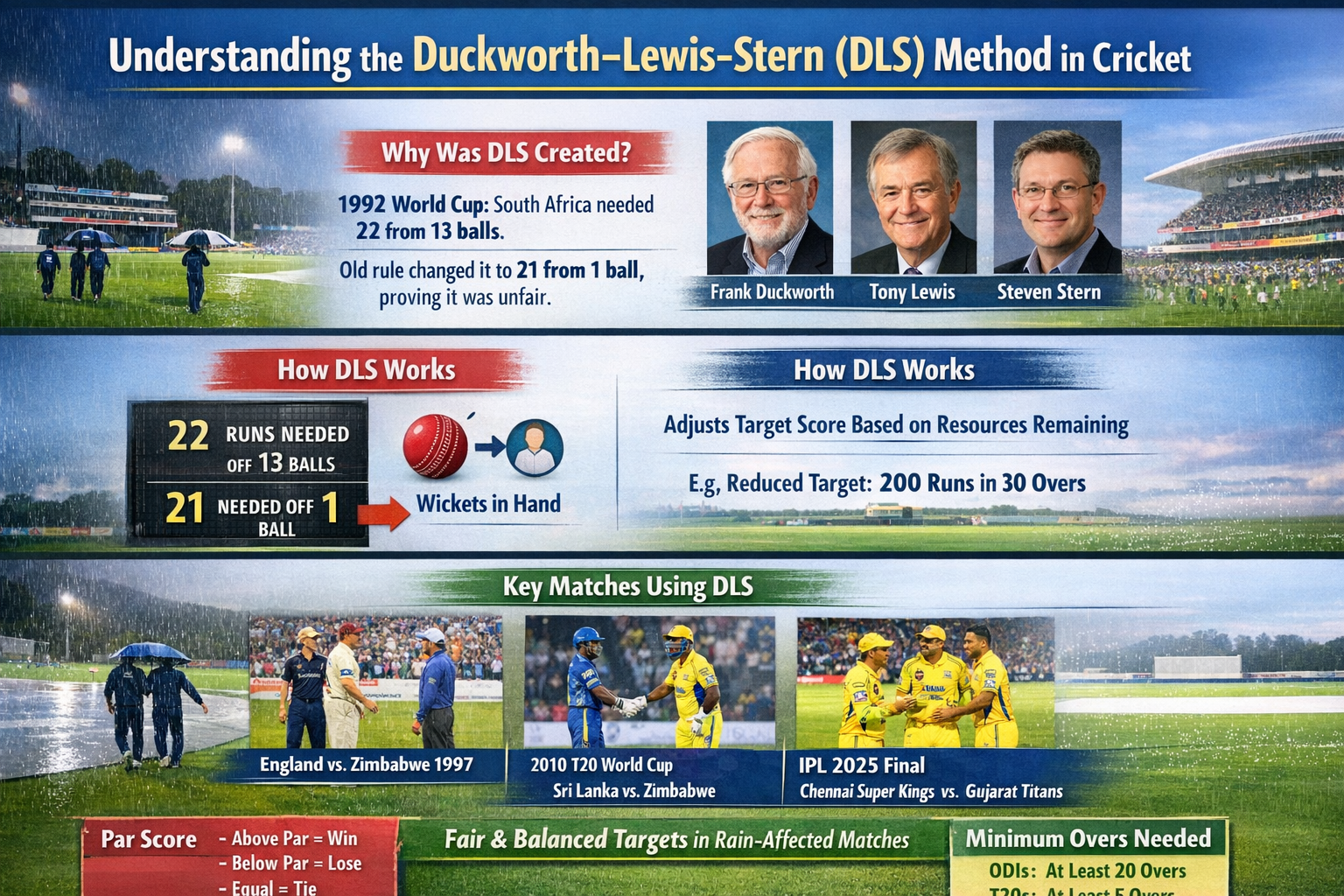
The idea for a better rule came after a famous World Cup game in 1992 between England and South Africa. When the rain stopped play, South Africa needed 22 runs from 13 balls. With the old rule in place, their goal changed to 21 runs from just 1 ball, which was nearly impossible because the most runs that can be scored from one ball is 6. This proved that the old system didn't work very well.
Frank Duckworth and Tony Lewis, two statisticians, began working on a new way to make scoring fair when games are stopped because of this issue. They looked at a lot of games and came up with a way to use both overs left and wickets in hand as resources for batting.
The DLS Method's History and Name
The method was first used in an international cricket match on January 1, 1997, during the second game of an ODI series between Zimbabwe and England. Even though it rained during the game, Zimbabwe still won. This was the first time the new method was used in the real world.
The International Cricket Council (ICC) officially adopted the system for all matches affected by rain in 1999, after trying it out. Later, statistician Steven Stern helped make the method better, and it became known as the Duckworth–Lewis–Stern method, or DLS.
Over time, the full method has been changed to work better with how people score now. DLS is used in almost every limited-overs game in the world when it rains.
A Simple Explanation of How the DLS Method Works
Cricket experts say that a batting team has two main tools:
- How many balls are left to play?
- Wickets in hand: how many batters are still in the game?
A team has all of its resources (all overs and all wickets) when the game starts. As overs are bowled and wickets fall, the resources go down. DLS then figures out how many resources a team has used and how many are still available.
When rain stops the match: - DLS lowers the second team's target if they have fewer overs than the first team.
- DLS might raise the second team's target from what it would have been if the first team's innings had been cut short. This is because the second team might have more resources.
- DLS doesn't just divide things up; it uses tables made from many past matches. These tables show how the chances of scoring change based on the number of overs and wickets. These tables help a computer or calculator quickly figure out the new target during a match.
What does "par score" mean?
When DLS is used, the match may stop during the second team's innings. In these situations, DLS gives you a par score.
- The second team wins if they have more runs than the par score when the game ends.
- They lose if they have fewer runs.
- If they have the same score as par, the game is tied.
- The par score is the score that the second team should have gotten by that point if both teams had the same resources.
Minimum Overs for a DLS Result
There must be a certain number of overs played for a DLS match that is affected by rain to have a result:
- In One-Day Internationals (ODIs), every team has to play at least 20 overs.
- In Twenty20 (T20) games, each team has to play at least five overs.
If this minimum isn't met (the game ends too soon), the match is called a no result, and points may be shared in tournaments.
DLS in Action in Real Games
Many important games around the world have used DLS. Here are some clear examples from real life where the method was used:
1. England vs. Zimbabwe, January 1, 1997
This was the first time DLS was used in a game between countries. Zimbabwe and England were playing a one-day game that was affected by rain. The DLS method was used when it rained, and Zimbabwe won by seven runs.
2. Matches in the Cricket World Cup (different years)
Rain cut short a number of important games during the Cricket World Cup. DLS changed the target for the team batting second in a lot of cases so that the match could still have a fair result even with fewer overs.
3. The 2010 T20 World Cup match between Sri Lanka and Zimbabwe
Sri Lanka scored 173 runs in 20 overs during the T20 World Cup. Zimbabwe started to chase, but the rain cut their innings short to 12 overs. DLS changed the target, and Sri Lanka won by 14 runs using the new method.
4.The Final of the 2023 Indian Premier League (IPL)
The IPL final between the Chennai Super Kings and the Gujarat Titans was stopped by rain. Using DLS, Chennai's goal was changed from 215 in 20 overs to 171 in 15 overs. The Chennai Super Kings won by five wickets.
Simple Example of a DLS Calculation
Think about this:
Team A bats first and gets 250 runs in 50 overs.
Team B starts to go after that goal. But the rain stops the game after 20 overs. Team B only has 30 overs left instead of the full 50 when the game starts again.
By using the DLS table:
- Team B now has fewer resources because they lost overs.
- The computer figures out a new target based on how many overs and wickets are left.
- Team B might not want to chase 251 runs; instead, they might want to chase something lower, like 200 runs.
- The exact number depends on how many resources they have lost and how many wickets they still have.
- The main point is that Team B's target is changed so that both teams have a fair chance, even though they don't play the same number of overs.
Why the DLS Method Matters
The DLS method is important because it makes sure that games are fair even when things go wrong. Without it, games that are affected by rain could have targets that are impossible or unfair and don't reflect how the game was going.
- DLS is used in a lot of tournaments, such as:
- World Cup of Cricket ICC
- World Cup T20 ICC
- IPL, or Indian Premier League
- The Big Bash League and a lot of other leagues around the world
DLS gives fair and balanced targets that keep matches exciting and competitive by looking at how well teams can score based on overs and wickets.
The DLS Method has some problems.
DLS is the best rain rule cricket has, but it's not perfect. Some of the problems are:
It doesn't take into account how the pitch plays on a certain day.
It doesn't know if a team has better or worse batters left.
It uses averages from a lot of matches, but sometimes strange match situations don't fit the averages perfectly.
These limits are still smaller than those of the old rules, and DLS is a lot fairer than the old ways.
How DLS Changed the Game of Cricket
DLS has been used in most limited-overs cricket matches that have been affected by rain since 1997. It has put an end to arguments about rain delays and made the game more fair for both teams.
Players, coaches, and captains now know that if it rains, the game won't just be decided by how many runs are left; it will also be decided by how many resources each team still has. DLS measures this.
Final Thoughts
The Duckworth–Lewis–Stern method is a fair way to figure out who wins a cricket match that has been affected by rain. It looks at the number of overs left and the number of wickets in hand, which are two important resources, to change targets when a match is cut short. It was first used in a match between Zimbabwe and England in 1997, and now it is used in big tournaments all over the world. DLS is the most fair and widely used way to decide what to do when a match is interrupted, even though no system is perfect.
**