
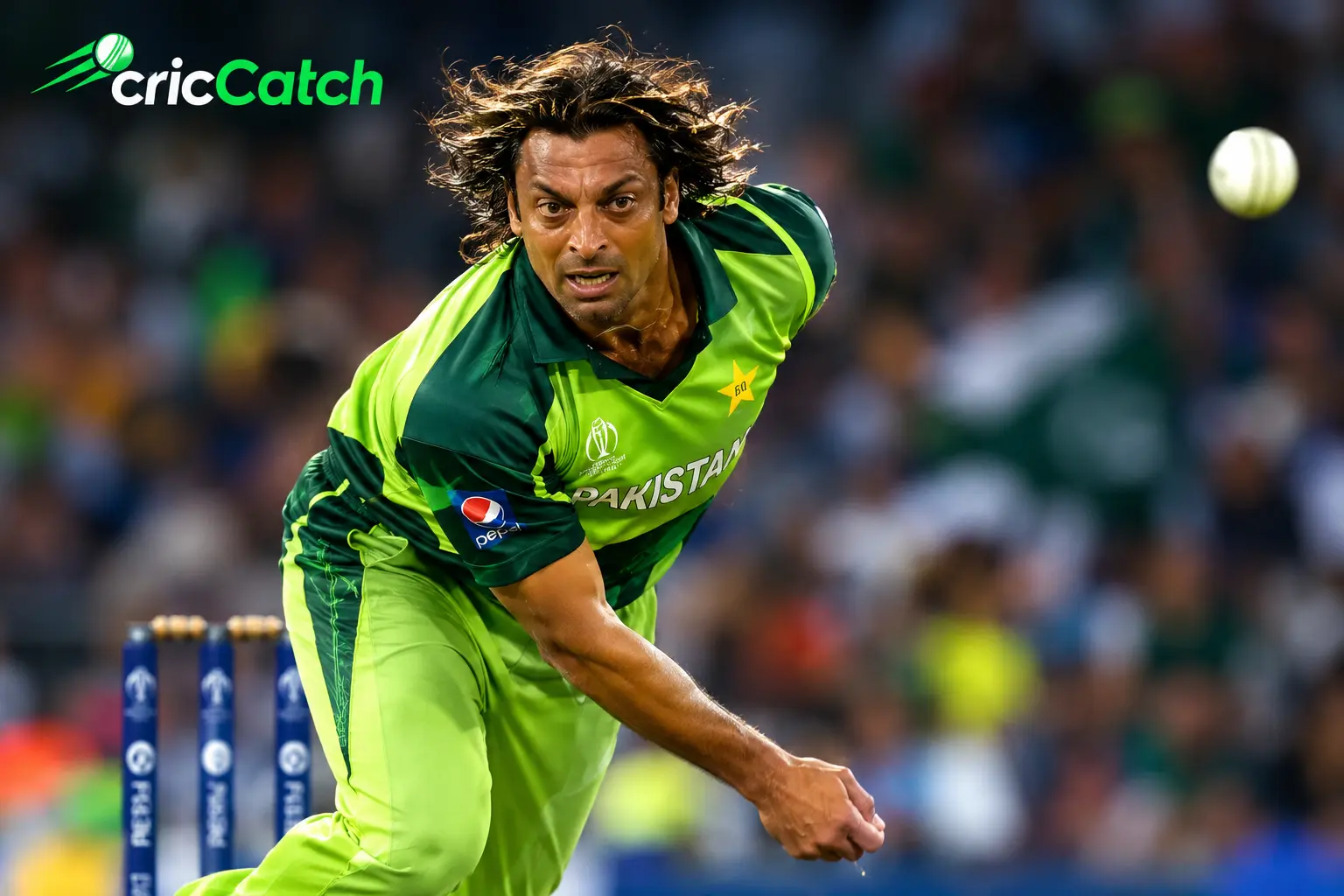
Fastest Bowlers in International Cricket: Speed Records
Fast bowling has always been one of the most exciting parts of international cricket. A delivery above 150 km/h gives the batter very little time to react, while crossing 160 km/h has been achieved by only a very small group of bowlers in recorded international cricket.
The biggest name on the list is Pakistan Shoaib Akhtar, whose 161.3 km/h delivery against England at the 2003 Cricket World Cup remains the highest electronically measured speed recorded in international cricket. Australia's Brett Lee, Shaun Tait and Mitchell Starc are also among the bowlers who have crossed the 160 km/h mark in recorded matches.
Fastest Bowlers in International Cricket by Recorded Speed
The list below focuses on the highest widely reported electronically measured speeds in international cricket. Because speed-gun technology has changed over time, older figures should be compared with some caution.
| Rank | Bowler | Country | Fastest Recorded Speed | Match/Year |
|---|---|---|---|---|
| 1 | Shoaib Akhtar | Pakistan | 161.3 km/h | vs England, 2003 |
| 2 | Brett Lee | Australia | 161.1 km/h | vs New Zealand, 2005 |
| 3 | Shaun Tait | Australia | 161.1 km/h | vs England, 2010 |
| 4 | Mitchell Starc | Australia | 160.4 km/h | vs New Zealand, 2015 |
| 5 | Jeff Thomson | Australia | 160+ km/h reported | 1970s |
| 6 | Mitchell Johnson | Australia | 150+ km/h regularly | International career |
| 7 | Mark Wood | England | 154+ km/h in ICC events | 2022 T20 World Cup |
| 8 | Lockie Ferguson | New Zealand | 154.55 km/h | 2022 T20 World Cup |
| 9 | Anrich Nortje | South Africa | 154.31 km/h | 2022 T20 World Cup |
| 10 | Haris Rauf | Pakistan | 150.75 km/h | 2022 T20 World Cup |
ICC's historical records confirm Akhtar's 161.3 km/h delivery and note that Lee and Tait also reached 161.1 km/h. Starc's 160.4 km/h delivery remains the fastest recorded in Test cricket.
Shoaib Akhtar Holds the Fastest Bowling Speed Record
Shoaib Akhtar remains the name most closely linked with the fastest delivery in international cricket. During Pakistan's 2003 World Cup match against England at Newlands in Cape Town, his speed gun recorded a delivery at 161.3 km/h, or about 100.2 mph.
The delivery is still listed by Guinness World Records as the highest electronically measured speed for a cricket ball. ICC also describes Akhtar's 161.3 km/h delivery as the fastest recorded ball in its historical speed coverage.
Akhtar's record was not simply about one delivery. He was known throughout his career for extreme pace, aggressive bowling and a long, powerful run-up. His ability to combine speed with bounce made him one of the most feared fast bowlers of his generation.
Brett Lee Reached 161.1 km/h for Australia
Australia's Brett Lee is one of the very few bowlers to have officially recorded a speed above 160 km/h in international cricket. His highest widely recorded speed is 161.1 km/h.
Lee was already known for extreme pace during the early part of his international career. ICC records from the 2003 World Cup show that he reached 160.7 km/h against England during the tournament. He later produced his 161.1 km/h delivery against New Zealand in Napier in 2005.
His pace was especially dangerous because he could maintain high speed while attacking the stumps and bowling short balls. Lee also combined raw pace with a strong international record across Tests and ODIs.
Shaun Tait Also Crossed the 161 km/h Mark
Shaun Tait joined the 160 km/h club with a delivery recorded at 161.1 km/h against England at Lord's in 2010.
Tait was different from many other fast bowlers because he relied heavily on raw speed and an explosive action. His international career was mainly focused on shorter formats, partly because the physical demands of his bowling style made long spells difficult.
ICC reported that Tait's 161.1 km/h delivery was the second-fastest ball in history at that time.
Mitchell Starc Owns the Fastest Test Delivery
Australia's Mitchell Starc holds a special place in the speed-record discussion because his 160.4 km/h delivery was recorded in a Test match.
Starc bowled the delivery against New Zealand at the WACA in Perth on 15 November 2015. The ball was measured at 160.4 km/h and was recorded against Ross Taylor. Guinness lists it as the fastest ball bowled in a Test match.
This makes Starc the fastest bowler in terms of a recorded delivery specifically in Test cricket, even though Akhtar remains ahead on the overall international list.
Jeff Thomson and the Problem With Older Speed Records
Australian fast bowler Jeff Thomson is regularly included in discussions about the fastest bowlers ever. He bowled during the 1970s, when speed measurement was not as standardized as it is today.
Thomson has long been associated with deliveries around or above 160 km/h. However, some of the most famous claims about his maximum speed came from different measurement settings rather than the same type of modern speed-gun system used for later records.
This is why historical comparisons need care. Guinness notes that Thomson was reported to have delivered balls above 160 km/h in net sessions, while the most consistently recognized electronically measured international record belongs to Akhtar.
Fastest Bowlers to Reach 160 km/h in International Cricket
Only a very small number of bowlers have crossed the 160 km/h barrier in recorded international cricket.
| Bowler | Country | Recorded Speed | Format/Context |
|---|---|---|---|
| Shoaib Akhtar | Pakistan | 161.3 km/h | ODI, 2003 World Cup |
| Brett Lee | Australia | 161.1 km/h | International cricket |
| Shaun Tait | Australia | 161.1 km/h | ODI, 2010 |
| Mitchell Starc | Australia | 160.4 km/h | Test, 2015 |
ICC has specifically identified Akhtar, Lee, Tait and Starc among the bowlers who reached at least 160 km/h in recorded international cricket.
Crossing 160 km/h is extremely rare because bowling at that speed puts enormous demands on the bowler's body. It requires explosive lower-body power, a fast run-up, efficient energy transfer and a high-speed release.
Fastest Bowlers in Modern International Cricket
The modern era has produced several bowlers who regularly operate around the 145–155 km/h range, even if they have not broken the historic 160 km/h record.
At the 2022 Men's T20 World Cup, Mark Wood topped the tournament's speed list at 154.74 km/h. Lockie Ferguson reached 154.55 km/h, while Anrich Nortje recorded 154.31 km/h. Pakistan's Haris Rauf reached 150.75 km/h.
These numbers show that extreme pace is still a major weapon in modern T20 cricket. Bowlers do not need to reach 160 km/h to create pressure; sustained pace around 150 km/h can already make batting difficult.
Mark Wood Became One of England's Fastest Bowlers
England's Mark Wood became one of the most recognizable express fast bowlers of the modern era. At the 2022 T20 World Cup, he recorded the fastest delivery of the tournament at 154.74 km/h.
Wood was also known for maintaining high pace across spells rather than producing only one isolated fast delivery. His pace, bounce and short-ball threat made him a key part of England's white-ball bowling attack.
In September 2026, Wood announced his retirement from international cricket after representing England in 146 internationals. ICC described him as one of the fastest bowlers of his generation.
Lockie Ferguson and Anrich Nortje Among Modern Speedsters
New Zealand's Lockie Ferguson and South Africa's Anrich Nortje have also been regular names in discussions about modern express pace.
Ferguson reached 154.55 km/h at the 2022 T20 World Cup, while Nortje recorded 154.31 km/h during the same tournament. Both bowlers combine high pace with aggressive lengths, making them particularly dangerous in limited-overs cricket.
Their speeds also show how modern international cricket has moved toward athletic, high-intensity fast bowling. Teams now closely monitor workload, recovery and bowling mechanics because sustained extreme pace can place significant stress on the body.
Fastest Bangladeshi Bowler in International Cricket
Bangladesh's Nahid Rana has emerged as one of the fastest young bowlers in international cricket. ICC lists his fastest international delivery at 152 km/h, which makes him Bangladesh's fastest recorded international bowler.
Rana's rise is notable because he only began playing with a hard cricket ball relatively late compared with many professional cricketers. He quickly developed a reputation for raw pace and became capable of regularly operating above 140 km/h.
His 152 km/h delivery came against Pakistan and became a major milestone in Bangladesh's fast-bowling history.
Fastest Bowlers in Women's Cricket
Women's cricket also has its own speed records, and Shabnim Ismail is the standout name.
Ismail recorded 132.1 km/h while playing for Mumbai Indians against Delhi Capitals in the Women's Premier League in March 2024. ICC confirmed that it was the fastest recorded delivery in women's cricket at that time and the first recorded women's delivery to break the 130 km/h barrier.
Her fastest international delivery is recorded at 128 km/h, achieved against the West Indies in 2016. Therefore, the 132.1 km/h figure should not be presented as an international cricket record because it was achieved in domestic franchise cricket.
Interestingly, Ismail returned to international cricket in 2026 after previously retiring in 2023 and was included in South Africa's Women's T20 World Cup campaign.
Why Is 160 km/h So Difficult for Fast Bowlers?
Bowling at 160 km/h is not simply about running faster and throwing the ball harder. The bowler has to transfer energy from the run-up through the legs, hips, trunk, shoulder and arm before releasing the ball.
At extreme speeds, even a small technical problem can reduce pace or increase injury risk. Fast bowlers also have to repeat their action over several deliveries, which makes control just as important as maximum speed.
This is why the fastest bowlers are not necessarily the bowlers who win the most matches. Pace becomes most effective when it is combined with accuracy, movement, bounce and smart changes of length.
How Bowling Speed Is Measured in Cricket
Bowling speed is normally displayed through a speed gun or radar-based measurement system. The technology measures the speed of the ball around its release and presents the result in kilometres per hour.
However, speed measurements from different eras are not perfectly comparable. Equipment, calibration, camera systems and measurement methods can vary between venues and broadcasters.
Guinness specifically notes that the recording of delivery speeds is an inexact science because speed-gun technology has not always been uniform. This is especially important when comparing modern bowlers with fast bowlers from the 1970s and earlier.
Fastest Delivery vs Fastest Bowler: What Is the Difference?
The term fastest bowler can be confusing because a bowler's maximum speed and normal bowling speed are not the same thing.
For example, a player may record one delivery above 155 km/h but normally bowl around 145–150 km/h. Another bowler may consistently bowl in the high 140s without producing a single record-breaking delivery.
That is why speed records should be used as a way to measure a bowler's maximum recorded pace, not as a complete ranking of bowling quality.
Who Is the Fastest Bowler in International Cricket?
Based on the highest widely recognized electronically measured delivery, Shoaib Akhtar is the fastest bowler in international cricket, with a recorded speed of 161.3 km/h against England in the 2003 World Cup.
Brett Lee and Shaun Tait are next on the commonly cited list at 161.1 km/h, while Mitchell Starc is next with 160.4 km/h. Starc's number is especially notable because it was recorded in a Test match.
Fastest Recorded International Deliveries
| Rank | Bowler | Country | Speed |
|---|---|---|---|
| 1 | Shoaib Akhtar | Pakistan | 161.3 km/h |
| 2 | Brett Lee | Australia | 161.1 km/h |
| 3 | Shaun Tait | Australia | 161.1 km/h |
| 4 | Mitchell Starc | Australia | 160.4 km/h |
| 5 | Jeff Thomson | Australia | 160+ km/h reported |
The first four figures have strong documented support from ICC and Guinness sources. Thomson's figure should be treated separately because historical measurement conditions were different.
Frequently Asked Questions About Fastest Bowlers
Who bowled the fastest ball in international cricket?
Shoaib Akhtar holds the widely recognized record with a delivery measured at 161.3 km/h against England during the 2003 World Cup.
Who is the fastest bowler to reach 160 km/h?
Shoaib Akhtar is the first name on the recognized international list, with 161.3 km/h. Brett Lee, Shaun Tait and Mitchell Starc also reached at least 160 km/h in recorded international cricket.
What is the fastest delivery in Test cricket?
Mitchell Starc holds the recorded Test mark at 160.4 km/h, delivered against New Zealand at the WACA in Perth in 2015.
Did Brett Lee bowl at 161 km/h?
Yes. Brett Lee is widely recorded at 161.1 km/h, placing him among the very small group of bowlers to cross the 160 km/h mark.
Did Shaun Tait bowl at 161 km/h?
Yes. Tait recorded 161.1 km/h against England at Lord's in 2010.
Who is the fastest woman bowler?
Shabnim Ismail holds the fastest recorded women's cricket delivery at 132.1 km/h, achieved for Mumbai Indians in the 2024 Women's Premier League. Her fastest international delivery was 128 km/h against West Indies in 2016.
Who is the fastest Bangladeshi bowler?
Nahid Rana holds Bangladesh's recorded international speed mark at 152 km/h.
Final Takeaway
The fastest-bowling record in international cricket remains one of the most famous speed records in the sport. Shoaib Akhtar's 161.3 km/h delivery remains the benchmark, with Brett Lee and Shaun Tait just behind at 161.1 km/h and Mitchell Starc holding the fastest recorded Test delivery at 160.4 km/h.
Modern bowlers such as Mark Wood, Lockie Ferguson, Anrich Nortje and Nahid Rana show that express pace is still a major part of international cricket. At the same time, the history of speed records shows why numbers should always be viewed in context: a fast delivery is impressive, but pace becomes truly dangerous when it comes with accuracy, movement and control.
**