
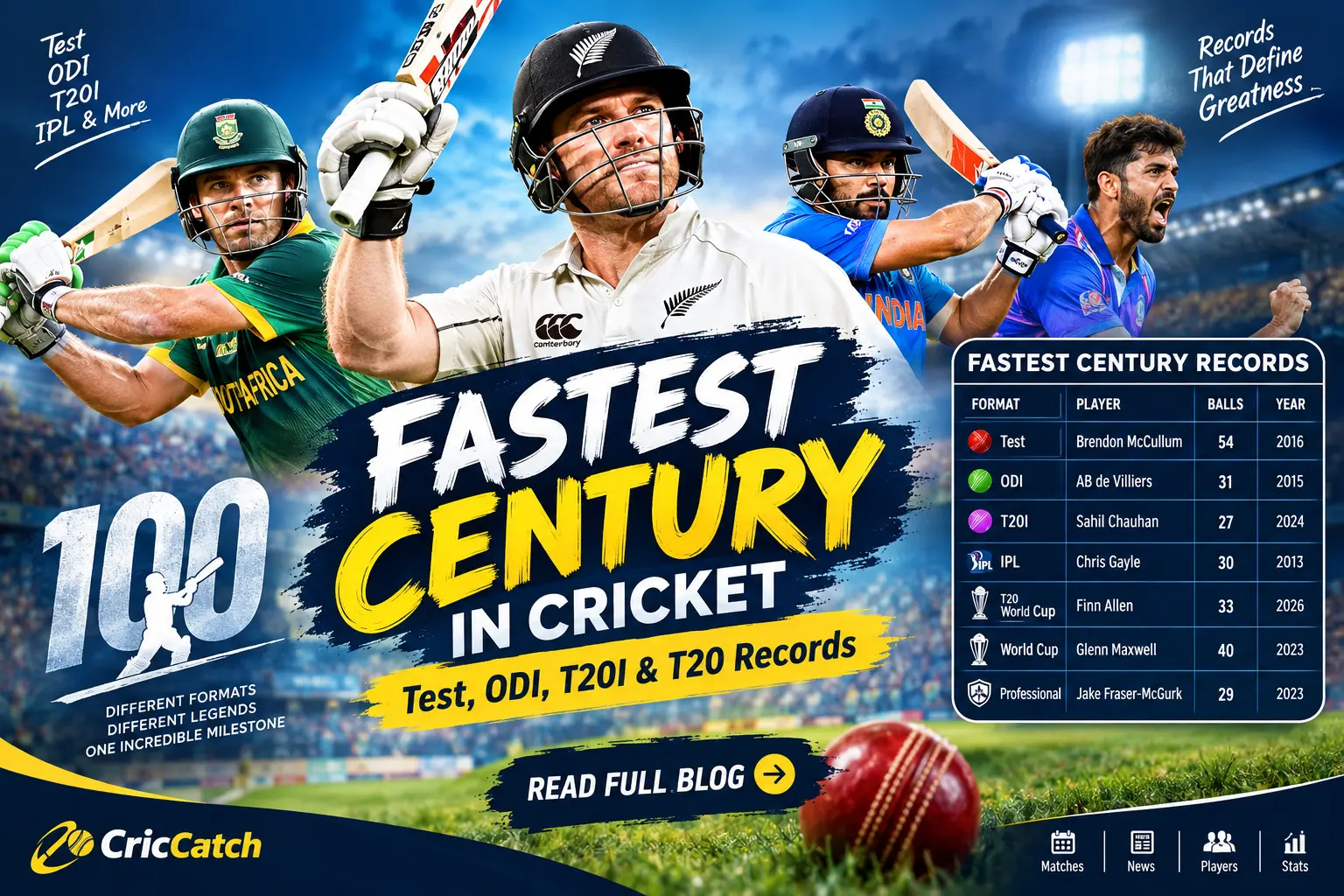
Fastest Century in Cricket: Test, ODI, T20I & T20 Records
A cricket century is one of the biggest batting milestones, but reaching 100 runs quickly is a completely different challenge. The record depends on the format and competition, so the fastest century in Test cricket is not the same as the fastest century in ODI, T20I, IPL or other domestic cricket.
In men's cricket, Brendon McCullum holds the fastest Test century record with a 54-ball hundred, while AB de Villiers holds the men's ODI record with 31 balls. Sahil Chauhan holds the men's T20I record with a 27-ball century. In September 2026, Abhishek Sharma scored a 30-ball century against Afghanistan, making it India's fastest T20I century and the third-fastest men's T20I century at that time.
Who Has the Fastest Century in Cricket?
There is no single answer unless the format or competition is clearly defined. Different cricket records are maintained for Test cricket, ODI cricket, T20I cricket, IPL, World Cups, women's cricket and domestic professional cricket.
The fastest widely recognized men's international century in the Guinness category is AB de Villiers' 31-ball ODI hundred against West Indies in 2015. However, Sahil Chauhan has a faster 27-ball century in men's T20Is, while Jake Fraser-McGurk has a 29-ball century in professional cricket under Guinness's broader domestic-or-international cricket category. These records are not contradictory because they belong to different record categories.
| Format or Competition | Player | Balls | Against | Year |
|---|---|---|---|---|
| Test | Brendon McCullum | 54 | Australia | 2016 |
| ODI | AB de Villiers | 31 | West Indies | 2015 |
| Men's T20I | Sahil Chauhan | 27 | Cyprus | 2024 |
| IPL | Chris Gayle | 30 | Pune Warriors India | 2013 |
| Men's T20 World Cup | Finn Allen | 33 | South Africa | 2026 |
| Men's Cricket World Cup | Glenn Maxwell | 40 | Netherlands | 2023 |
| Professional cricket, Guinness category | Jake Fraser-McGurk | 29 | Tasmania | 2023 |
The key point is simple: always check the format before comparing two fastest-century records.
What Is the Fastest Century in Test Cricket?
Test cricket gives batters much more time than limited-overs formats, which makes an extremely fast century especially unusual. The current men's Test record belongs to New Zealand's Brendon McCullum, who reached 100 from 54 balls against Australia in Christchurch in February 2016.
Who Holds the Fastest Test Century Record?
Brendon McCullum holds the fastest men's Test century record. He reached his hundred in only 54 deliveries against Australia at Hagley Oval, Christchurch, during his final Test match in February 2016. He continued attacking after reaching three figures and finished with 145 from 79 balls.
His innings came when New Zealand were in a difficult position, but McCullum attacked almost immediately. The 54-ball century remains one of the most unusual scoring feats in Test cricket because Test innings normally involve much more defensive and controlled batting.
How Many Balls Did Brendon McCullum Take?
McCullum needed 54 balls to reach his century. That means he reached 100 before facing even 60 deliveries, an extraordinary scoring rate for a Test match.
His 54-ball century broke a record that had stood at 56 balls. McCullum's innings therefore improved the previous mark by only two deliveries, showing how difficult it is to create a new record at this level.
Who Held the Test Record Before McCullum?
Before McCullum, Viv Richards held the record after reaching a Test century from 56 balls against England in 1986. Pakistan captain Misbah-ul-Haq later matched Richards' 56-ball record against Australia in Abu Dhabi in 2014.
McCullum eventually moved the record from 56 balls to 54. This gives the record a clear history:
Viv Richards — 56 balls → Misbah-ul-Haq — 56 balls → Brendon McCullum — 54 balls.
What Are the Top Fastest Test Centuries?
The leading men's Test centuries by balls faced are:
| Rank | Player | Balls | Opposition | Year |
|---|---|---|---|---|
| 1 | Brendon McCullum | 54 | Australia | 2016 |
| 2 | Viv Richards | 56 | England | 1986 |
| 2 | Misbah-ul-Haq | 56 | Australia | 2014 |
| 4 | Adam Gilchrist | 57 | England | 2006 |
| 5 | Jack Gregory | 67 | South Africa | 1921 |
| 6 | Shivnarine Chanderpaul | 69 | Australia | 2003 |
| 6 | David Warner | 69 | India | 2012 |
| 6 | Travis Head | 69 | England | 2025 |
| 9 | Chris Gayle | 70 | Australia | 2009 |
| 10 | Roy Fredericks | 71 | Australia | 1975 |
The list shows how rare these performances are. Only a small number of Test batters have reached 100 in fewer than 70 balls. The current record list also includes Travis Head's 69-ball century against England in 2025.
Why Is a 54-Ball Test Century So Rare?
A Test match does not force a batter to score quickly. There are no 20-over limits on an innings, so a batter can normally spend a long time building an innings.
To score 100 from 54 balls, a batter needs an unusually high number of boundaries and very few dot balls. It also requires the batter to attack quality Test bowling without losing their wicket. That combination explains why McCullum's record has remained so difficult to break.
What Is the Fastest Century in ODI Cricket?
The fastest men's ODI century is held by South Africa's AB de Villiers, who reached 100 from only 31 balls against West Indies in Johannesburg on 18 January 2015. His final score was 149 from 44 balls.
Who Holds the Fastest ODI Century Record?
AB de Villiers holds the men's ODI record with a 31-ball century. He reached the milestone against West Indies at the New Wanderers Stadium during an extraordinary South African batting performance.
This record is famous because it came in a 50-over format rather than a T20 match. De Villiers used powerful hitting and unusual shot selection to reach the landmark at an incredible speed.
How Many Balls Did AB de Villiers Take?
AB de Villiers needed only 31 balls to score his century.
He reached his fifty from 16 balls and then accelerated even further. His century contained eight fours and 10 sixes, meaning 92 of his first 100 runs came directly from boundaries. He eventually finished with 149 from 44 balls, including 16 sixes and nine fours.
Who Held the ODI Record Before AB de Villiers?
Before de Villiers, New Zealand's Corey Anderson held the record with a 36-ball century against West Indies in 2014. Before Anderson, Pakistan's Shahid Afridi had held the record with a 37-ball century against Sri Lanka in 1996.
The progression was therefore:
Shahid Afridi — 37 balls → Corey Anderson — 36 balls → AB de Villiers — 31 balls.
De Villiers created a much bigger jump than the previous record changes, reducing the mark by five deliveries.
What Are the Top Fastest ODI Centuries?
| Rank | Player | Balls | Opposition | Year |
|---|---|---|---|---|
| 1 | AB de Villiers | 31 | West Indies | 2015 |
| 2 | Corey Anderson | 36 | West Indies | 2014 |
| 3 | Shahid Afridi | 37 | Sri Lanka | 1996 |
| 4 | Glenn Maxwell | 40 | Netherlands | 2023 |
| 5 | Asif Khan | 41 | Nepal | 2023 |
| 6 | Mark Boucher | 44 | Zimbabwe | 2006 |
| 7 | Brian Lara | 45 | Bangladesh | 1999 |
| 7 | Shahid Afridi | 45 | India | 2005 |
| 9 | Jesse Ryder | 46 | West Indies | 2014 |
| 9 | Jos Buttler | 46 | Pakistan | 2015 |
Recent ODI records have added several explosive innings to the top list, including Glenn Maxwell's 40-ball hundred and Asif Khan's 41-ball century in 2023. The 31-ball mark of AB de Villiers remains at the top.
Why Is AB de Villiers 31-Ball Record So Special?
The record is special because de Villiers did not simply reach 100 quickly; he continued scoring at an extraordinary rate and finished on 149 from 44 balls.
His innings included 16 sixes, while South Africa finished on 439/2. Guinness records the 31-ball innings as the fastest ODI hundred and also lists it as the fastest international century in its international-cricket record category.
What Is the Fastest Century in T20 Cricket?
T20 cricket and T20I cricket should not automatically be treated as the same record category. T20 can refer to domestic or international professional competitions, while T20I specifically refers to official international Twenty20 matches.
Sahil Chauhan's 27-ball century for Estonia against Cyprus is the men's T20I record. Separately, Chris Gayle holds the IPL record with a 30-ball century, while Jake Fraser-McGurk has a 29-ball century recognized by Guinness as the fastest in its broad professional-cricket category covering domestic or international T20, List A or first-class cricket.
What Is the Difference Between T20 and T20I?
T20 is the short form of Twenty20 cricket, where each team normally has a maximum of 20 overs.
T20I means Twenty20 International and refers specifically to official international matches between national teams. A domestic T20 league such as the IPL and an international T20I therefore belong to different record categories.
This distinction is important when someone searches for the "fastest T20 century." The answer can change depending on whether they mean T20I, IPL or professional cricket as a wider category.
Who Has the Fastest T20 Century?
For men's T20Is, Sahil Chauhan has the current record with a 27-ball century. He scored 144 not out from 41 balls for Estonia against Cyprus on 17 June 2024. His innings included 18 sixes and 24 boundaries in total.
The wider professional-cricket category is different. Guinness currently lists Jake Fraser-McGurk's 29-ball century for South Australia against Tasmania in the 2023 Marsh Cup as the fastest century in its category covering domestic or international T20, List A or first-class cricket.
Why Is the T20 Record Different from the IPL Record?
The IPL is one specific T20 competition, so its record is maintained separately.
Chris Gayle scored an IPL century from 30 balls for Royal Challengers Bangalore against Pune Warriors India in 2013. He eventually finished with 175 not out from 66 balls. The IPL's official match report described his 30-ball hundred as the fastest century in T20 cricket at that time.
Therefore:
- Men's T20I: Sahil Chauhan — 27 balls
- IPL: Chris Gayle — 30 balls
- Guinness professional-cricket category: Jake Fraser-McGurk — 29 balls
These records should not be merged into one list without explaining the category.
What Is the Fastest Century in T20I Cricket?
The fastest men's T20I century is currently Sahil Chauhan's 27-ball hundred for Estonia against Cyprus. He broke Jan Nicol Loftie-Eaton's 33-ball record in June 2024.
Who Holds the Fastest T20I Century Record?
Sahil Chauhan holds the men's T20I record with a century from 27 balls. He reached 100 while Estonia chased Cyprus' target in a remarkable batting performance.
Chauhan finished unbeaten on 144 from 41 balls and scored 18 sixes. His final strike rate was 351.21, showing just how quickly he converted the innings into a record-breaking hundred.
Who Scored a 27-Ball T20I Century?
Sahil Chauhan of Estonia scored the famous 27-ball T20I century against Cyprus on 17 June 2024.
His 144 not out included 18 sixes and six fours. The century was six balls faster than the previous record of 33 balls, held by Namibia's Jan Nicol Loftie-Eaton.
Who Held the T20I Record Before Sahil Chauhan?
Before Chauhan, Namibia's Jan Nicol Loftie-Eaton had reached 100 from 33 balls against Nepal in February 2024.
The 33-ball mark was later matched by Zimbabwe's Sikandar Raza and remained one of the fastest T20I centuries before Chauhan moved the record to 27 balls.
Where Does Abhishek Sharma's 30-Ball Century Rank?
Abhishek Sharma scored a 30-ball century for India against Afghanistan in Delhi on 17 September 2026. ICC reported that it was the fastest T20I century by an Indian batter and the third-fastest men's T20I century overall at that time.
Abhishek reached his fifty from only 16 balls and finished with 108 from 34 balls, including 11 sixes. His 30-ball hundred therefore sits behind Sahil Chauhan's 27-ball record and ahead of the 33-ball marks held by several players.
What Are the Top Fastest T20I Centuries?
| Rank | Player | Balls | Team | Opposition | Year |
|---|---|---|---|---|---|
| 1 | Sahil Chauhan | 27 | Estonia | Cyprus | 2024 |
| 2 | Muhammad Fahad | 29 | Bahrain | Turkey | 2025 |
| 3 | Abhishek Sharma | 30 | India | Afghanistan | 2026 |
| 4 | Finn Allen | 33 | New Zealand | South Africa | 2026 |
| 4 | Sikandar Raza | 33 | Zimbabwe | Gambia | 2024 |
| 4 | Jan Nicol Loftie-Eaton | 33 | Namibia | Nepal | 2024 |
| 7 | David Miller | 35 | South Africa | Bangladesh | 2017 |
| 7 | Rohit Sharma | 35 | India | Sri Lanka | 2017 |
Sahil Chauhan remains the clear men's T20I record holder at 27 balls. Abhishek Sharma's 30-ball innings is especially important for Indian cricket because it moved the India record from Rohit Sharma's 35-ball century to 30 balls.
Is the Fastest T20I Century Also the Fastest T20 Century?
Not necessarily, because "T20" can cover several competitions while "T20I" is a specific international category.
Sahil Chauhan's 27-ball century is the men's T20I record. Chris Gayle's 30-ball century is the IPL record, and Jake Fraser-McGurk's 29-ball century is recognized by Guinness in its broader professional-cricket category. The correct answer therefore depends on the exact record category being searched.
Who Scored the Fastest Century in International Cricket?
AB de Villiers 31-ball ODI century against West Indies is listed by Guinness as the fastest century in its international-cricket record category. He reached 100 in 31 balls at Johannesburg on 18 January 2015.
This can look confusing because Sahil Chauhan later scored a 27-ball century in a T20I. The difference comes from the way record categories are defined and maintained. Sahil owns the men's T20I record, while Guinness separately lists AB de Villiers for its international-cricket record category. Therefore, the safest approach is to state the exact category instead of calling one number the universal fastest century in every type of cricket.
Why Is AB de Villiers' Record Different from Sahil Chauhan's?
AB de Villiers' 31-ball record came in an ODI, while Sahil Chauhan's 27-ball record came in a T20I.
Both are international cricket, but they are different formats. Record databases may also maintain separate records for a specific format and broader categories.
What Counts as an International Century?
An international century is scored in an officially recognized international match, such as a Test, ODI or T20I.
A domestic league innings, even if it is one of the biggest cricket leagues in the world, belongs to a different record category. This is why Chris Gayle's IPL century and Sahil Chauhan's T20I century should not be treated as the same record.
Who Scored the Fastest Century Against a Full Member Team?
A Full Member is a national cricket board with full ICC membership and Test status. This matters because some record comparisons separate performances against Full Member teams from performances involving Associate nations.
Abhishek Sharma's 30-ball century against Afghanistan in September 2026 is an important example. It was India's fastest T20I century and was reported by ICC as the third-fastest men's T20I century overall at that point.
The category should still be stated clearly because Sahil Chauhan's 27-ball record for Estonia against Cyprus remains the overall men's T20I record.
What Is the Fastest Century in IPL History?
Chris Gayle holds the IPL record for the fastest century, reaching 100 from 30 balls for Royal Challengers Bangalore against Pune Warriors India in Bengaluru on 23 April 2013.
How Fast Did Chris Gayle Reach 100?
Gayle reached his century in only 30 balls and continued his assault to finish unbeaten on 175 from 66 balls.
His innings included 13 fours and 17 sixes. It remains one of the most famous individual batting performances in IPL history, and the IPL record for fastest century remains 30 balls.
Is Gayle's Record the Fastest in All Professional Cricket?
No. This is where record categories become important.
Guinness currently lists Jake Fraser-McGurk's 29-ball century for South Australia against Tasmania in the 2023 Marsh Cup as the fastest century in its professional-cricket category covering domestic or international T20, List A or first-class cricket.
So the records are:
| Record Category | Player | Balls |
|---|---|---|
| IPL | Chris Gayle | 30 |
| Men's T20I | Sahil Chauhan | 27 |
| Guinness professional cricket category | Jake Fraser-McGurk | 29 |
This is why an article should never simply say "Chris Gayle has the fastest professional century" without explaining that Guinness's broader professional-cricket record has since moved to Fraser-McGurk's 29-ball century.
What Are the Fastest Century Records by Major Cricket Competition?
Fastest-century records can also be grouped by major competitions. This makes it easier to understand why a player can hold a competition record without holding the overall format record.
| Competition or Format | Player | Balls | Year |
|---|---|---|---|
| Men's T20I | Sahil Chauhan | 27 | 2024 |
| IPL | Chris Gayle | 30 | 2013 |
| ODI | AB de Villiers | 31 | 2015 |
| Men's T20 World Cup | Finn Allen | 33 | 2026 |
| Men's Cricket World Cup | Glenn Maxwell | 40 | 2023 |
| Test | Brendon McCullum | 54 | 2016 |
What Is the Fastest T20 World Cup Century?
Finn Allen holds the men's T20 World Cup record after scoring a 33-ball century for New Zealand against South Africa in the 2026 semi-final.
His unbeaten 100 came from 33 balls and broke Chris Gayle's previous T20 World Cup record of 47 balls, set against England in 2016.
What Is the Fastest Cricket World Cup Century?
Glenn Maxwell holds the men's Cricket World Cup record with a 40-ball century against Netherlands in Delhi on 25 October 2023.
Maxwell scored 106 from 44 balls and reached his century with eight fours and eight sixes. His 40-ball mark replaced Aiden Markram's 49-ball century, which had been set only 18 days earlier.
What Is the Fastest Century in Women's Cricket?
Women's cricket has its own record categories, and these should be kept separate from men's records.
Deandra Dottin holds the women's T20I record with a 38-ball century for West Indies against South Africa in 2010. Meg Lanning holds the women's ODI record with a 45-ball century against New Zealand in 2012. In domestic women's T20 cricket, Kiran Navgire reached 100 from 34 balls for Maharashtra against Punjab in 2025.
What Is the Fastest Women's T20I Century?
Deandra Dottin holds the women's T20I record with a 38-ball century for West Indies against South Africa on 5 May 2010.
She finished on 112 not out from 45 balls, with nine sixes and five fours. Guinness also lists the 38-ball innings as the fastest women's international century.
What Is the Fastest Women's ODI Century?
Meg Lanning holds the women's ODI record with a 45-ball century against New Zealand in Sydney in December 2012.
She scored 103 from 45 balls, including 18 fours and three sixes.
What Is the Fastest Women's Domestic T20 Century?
Kiran Navgire scored a women's domestic T20 century from 34 balls for Maharashtra against Punjab in the Senior Women's T20 Trophy in October 2025.
She finished unbeaten on 106 from 35 balls. Guinness lists the 34-ball century as the fastest women's T20 hundred in its record category.
Fastest Century Records by Format
The following table gives a quick record snapshot across the main categories:
| Format / Competition | Player | Balls | Opposition | Year |
|---|---|---|---|---|
| Test | Brendon McCullum | 54 | Australia | 2016 |
| ODI | AB de Villiers | 31 | West Indies | 2015 |
| Men's T20I | Sahil Chauhan | 27 | Cyprus | 2024 |
| IPL | Chris Gayle | 30 | Pune Warriors India | 2013 |
| Men's T20 World Cup | Finn Allen | 33 | South Africa | 2026 |
| Men's Cricket World Cup | Glenn Maxwell | 40 | Netherlands | 2023 |
| Women's T20I | Deandra Dottin | 38 | South Africa | 2010 |
| Women's ODI | Meg Lanning | 45 | New Zealand | 2012 |
| Women's domestic T20 | Kiran Navgire | 34 | Punjab | 2025 |
The 27-ball T20I mark is the shortest number in this table, but that does not make it the record for every cricket category. Each record needs to be read with its format and competition.
How Is a Fastest Century Measured?
A fastest century is measured by the number of legal deliveries a batter faces before reaching 100 runs.
For example:
- 27 balls = century reached after facing 27 deliveries
- 30 balls = century reached after facing 30 deliveries
- 31 balls = century reached after facing 31 deliveries
- 54 balls = century reached after facing 54 deliveries
The final score is not what decides the fastest-century record. A player can score 175 not out, like Chris Gayle, but the record is based on how many balls were needed to reach 100.
This is also why balls and minutes should not be confused. A batter may reach a century in fewer balls but take more clock time because of wickets, reviews, drinks breaks, innings interruptions or other match delays.
How Fast Can a Batter Score 100 Runs?
The fastest century records show just how extreme the scoring rate can become.
If a player scores 100 runs from:
- 27 balls, that is an average of about 3.70 runs per ball
- 30 balls, about 3.33 runs per ball
- 31 balls, about 3.23 runs per ball
- 54 balls, about 1.85 runs per ball
These are simple averages, not actual ball-by-ball scoring patterns. In a real innings, the batter usually combines fours, sixes, singles, twos and occasional dot balls.
Sahil Chauhan's 27-ball century is a good example of extreme boundary hitting. He scored 144 not out from 41 balls with 18 sixes and six fours.
Fastest Century vs Fastest Fifty: Are They the Same Record?
No. A fastest fifty and a fastest century are two different records.
A batter can have a very fast fifty but then slow down, or start quickly and accelerate even more after reaching 50.
Abhishek Sharma's 2026 T20I innings is a clear example. He reached his fifty from 16 balls, then completed his century from 30 balls and eventually finished with 108 from 34 deliveries.
AB de Villiers also held the ODI record for the fastest fifty at 16 balls during his famous 31-ball century innings.
How Have the Fastest Century Records Changed Over Time?
Fastest-century records have gradually moved lower as aggressive batting has become more common, but the change is not the same in every format.
Test Century Record Timeline
Viv Richards — 56 balls (1986)
↓
Misbah-ul-Haq — 56 balls (2014, equalled)
↓
Brendon McCullum — 54 balls (2016)
McCullum reduced the Test record by two balls.
ODI Century Record Timeline
Shahid Afridi — 37 balls (1996)
↓
Corey Anderson — 36 balls (2014)
↓
AB de Villiers — 31 balls (2015)
The ODI record made a much larger jump when de Villiers reduced the mark to 31 balls.
T20I Century Record Timeline
Jan Nicol Loftie-Eaton — 33 balls (2024)
↓
Sahil Chauhan — 27 balls (2024)
Later, Abhishek Sharma's 30-ball century became India's fastest T20I hundred in 2026.
Who Held the Fastest Century Record Before the Current Record Holder?
Record history helps explain how unusual the current marks really are.
Test Cricket
Viv Richards set the 56-ball mark in 1986. Misbah-ul-Haq equalled it in 2014 before Brendon McCullum moved the record to 54 balls in 2016.
ODI Cricket
Shahid Afridi's 37-ball century was followed by Corey Anderson's 36-ball hundred in 2014. AB de Villiers then broke the record with his 31-ball century in 2015.
Men's T20I Cricket
Jan Nicol Loftie-Eaton's 33-ball century was the record before Sahil Chauhan produced his 27-ball hundred in June 2024.
India's T20I Record
Rohit Sharma's 35-ball century had been India's fastest T20I hundred before Abhishek Sharma scored his century from 30 balls against Afghanistan in September 2026. ICC confirmed Abhishek's innings as India's fastest T20I century.
Records Fans Often Confuse
T20 vs T20I
T20 is the broader format, while T20I means an official international T20 match. An IPL record and a T20I record therefore belong to separate categories.
International vs Domestic Cricket
An international century is scored in an international match between national teams. Domestic competitions such as the IPL and Marsh Cup have their own records.
Overall vs Full Member Records
A record involving an Associate nation and a record involving a Full Member team can both be official, but they may answer different search questions.
Men's vs Women's Records
Men's and women's cricket maintain separate record categories. A women's T20I record should not be directly merged into the men's T20I list.
Balls vs Minutes
Fastest centuries are normally ranked by balls faced, not by the number of minutes from the start of an innings.
Format vs Competition
A player may hold a competition record without holding the overall format record. For example, Chris Gayle has the IPL record, while Sahil Chauhan has the men's T20I record.
Why Are Fastest Century Records So Difficult to Break?
A batter needs several things to come together to break a fastest-century record.
First, the batter needs exceptional power and timing. Second, there must be very few dot balls because every unused delivery makes the target harder. Third, the batter needs enough boundary opportunities and must survive long enough to reach 100.
The format also matters. A T20I batter can attack from the first ball because only 20 overs are available, while a Test batter normally has much more time. That is why a 27-ball T20I century and a 54-ball Test century should be viewed within their own formats.
Modern T20 batting has also increased the number of extremely fast scoring performances. Sahil Chauhan's 27-ball record and Abhishek Sharma's 30-ball India record are recent examples of how quickly T20I batting can develop.
FAQs;
Who has the fastest century in cricket?
The answer depends on the record category. Sahil Chauhan holds the men's T20I record with 27 balls, AB de Villiers holds the men's ODI record with 31 balls, Brendon McCullum holds the men's Test record with 54 balls, and Chris Gayle holds the IPL record with 30 balls.
Who scored 100 in 27 balls?
Sahil Chauhan scored a 27-ball century for Estonia against Cyprus in a men's T20I in June 2024.
Who scored 100 in 30 balls?
Chris Gayle scored an IPL century from 30 balls in 2013, while Abhishek Sharma scored a 30-ball T20I century for India against Afghanistan in September 2026.
Who scored the fastest ODI century?
AB de Villiers scored the fastest men's ODI century, reaching 100 from 31 balls against West Indies in Johannesburg in 2015.
Who scored the fastest Test century?
Brendon McCullum holds the men's Test record with a 54-ball century against Australia in Christchurch in 2016.
What is the fastest T20I century?
Sahil Chauhan holds the men's T20I record with a 27-ball century for Estonia against Cyprus in 2024.
What is India's fastest T20I century?
Abhishek Sharma holds India's fastest men's T20I century after reaching 100 from 30 balls against Afghanistan in September 2026.
What is the fastest IPL century?
Chris Gayle holds the IPL record with a 30-ball century for Royal Challengers Bangalore against Pune Warriors India in 2013.
Is the fastest T20 century the same as the fastest T20I century?
No. T20 can include domestic and professional competitions, while T20I refers specifically to international cricket. The record therefore depends on the category being used.
What is the fastest international century?
Guinness lists AB de Villiers' 31-ball ODI century as the fastest century in its international-cricket record category. Sahil Chauhan separately holds the men's T20I record with 27 balls.
What is the fastest women's T20I century?
Deandra Dottin holds the women's T20I record with a 38-ball century for West Indies against South Africa in 2010.
What is the fastest women's ODI century?
Meg Lanning holds the women's ODI record with a 45-ball century against New Zealand in 2012.
How are fastest centuries measured?
They are measured by the number of balls a batter faces before reaching 100 runs.
What is the fastest T20 World Cup century?
Finn Allen holds the men's T20 World Cup record with a 33-ball century against South Africa in 2026.
What is the fastest Cricket World Cup century?
Glenn Maxwell holds the men's Cricket World Cup record with a 40-ball century against Netherlands in 2023.
Final Record Snapshot
| Record | Player | Balls | Year |
|---|---|---|---|
| Fastest Test century | Brendon McCullum | 54 | 2016 |
| Fastest men's ODI century | AB de Villiers | 31 | 2015 |
| Fastest men's T20I century | Sahil Chauhan | 27 | 2024 |
| Fastest IPL century | Chris Gayle | 30 | 2013 |
| Fastest men's T20 World Cup century | Finn Allen | 33 | 2026 |
| Fastest men's Cricket World Cup century | Glenn Maxwell | 40 | 2023 |
| Fastest women's T20I century | Deandra Dottin | 38 | 2010 |
| Fastest women's ODI century | Meg Lanning | 45 | 2012 |
| Fastest women's T20 century, Guinness category | Kiran Navgire | 34 | 2025 |
| Fastest professional cricket century, Guinness category | Jake Fraser-McGurk | 29 | 2023 |
The biggest lesson from these records is that "fastest century in cricket" is not one simple record. Test, ODI, T20I, IPL, World Cups, women's cricket and broader professional cricket all have different categories.
For example, Sahil Chauhan's 27-ball century is the men's T20I record, AB de Villiers' 31-ball innings is the men's ODI record and Guinness's international-cricket record, Chris Gayle's 30-ball innings is the IPL record, while Jake Fraser-McGurk's 29-ball century is listed by Guinness in its broader professional-cricket category.
So when comparing the fastest centuries, always check the format, competition, gender category, international status and the exact record definition. This makes the record easier to understand and prevents different cricket records from being mixed together.
**