
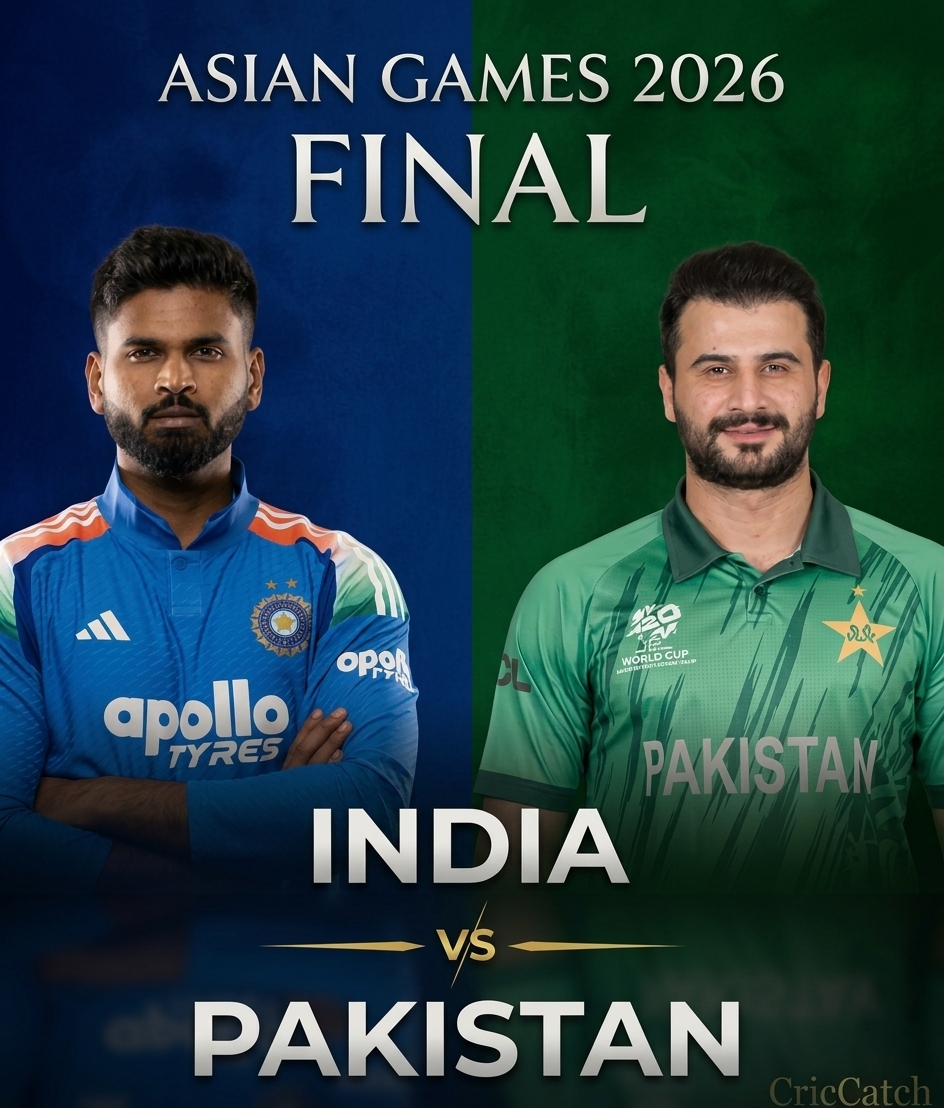
India vs Pakistan Asian Games 2026 Final: Can Pakistan Beat India?
The Asian Games 2026 men's cricket final is now set for a huge India vs Pakistan contest. Pakistan reached the gold-medal match after recovering from 53 for 4 to chase 112 against Bangladesh in a rain-shortened semi-final. Abdul Samad finished unbeaten on 30 from 15 balls and Hasan Nawaz made 27 not out, helping Pakistan win with nine balls remaining.
India reached the final in a very different way. Ishan Kishan unbeaten 80 from 46 balls helped India post 169 for 7 against Sri Lanka, before Jasprit Bumrah, Axar Patel and Abhishek Sharma led a huge bowling performance that dismissed Sri Lanka for only 45. That gives Pakistan a clear challenge, but the final is a new match where powerplay wickets, spin and finishing ability can quickly change the game.
Can Pakistan Beat India in the Asian Games 2026 Final?
Yes, Pakistan have realistic ways to challenge India, but the final will depend heavily on how well they handle India strong batting depth and varied bowling attack. Pakistan's route to the final has already shown one useful quality: they recovered from a difficult position against Bangladesh instead of allowing the chase to collapse. That ability to stay calm after losing early wickets could be important against India too.
At the same time, India enter the final after a much more complete semi-final performance. Their batting reached 169, while their bowlers removed Sri Lanka for 45. Pakistan will therefore need a disciplined batting plan rather than relying only on individual big hits. The gold-medal match is scheduled for October 3, and both teams have enough T20 quality to make the contest highly competitive.
Pakistan Route to the Asian Games 2026 Final
Pakistan journey was affected by rain from the beginning. Their quarter-final against Hong Kong was abandoned without a ball being bowled, with the higher-ranked teams moving through under the tournament's ranking-based qualification rules. Pakistan then faced Bangladesh in the first semi-final on October 1.
The semi-final was reduced to 13 overs per side. Bangladesh scored 111 for 7, with Towhid Hridoy making 42, while Sufyan Moqim took 3 for 26 and Arafat Minhas claimed 2 for 23. Pakistan slipped to 53 for 4 in the chase, but Abdul Samad and Hasan Nawaz added an unbeaten 59-run partnership to take Pakistan to 112 for 4 in only 11.3 overs.
India Route to the Asian Games 2026 Final
India also had their quarter-final affected by rain, with their scheduled match against Afghanistan abandoned. India advanced to the semi-final based on their higher T20I ranking and then met Sri Lanka in the last four. This means India did not need to play a quarter-final before facing Sri Lanka.
Against Sri Lanka, India produced one of the strongest performances of the tournament. Ishan Kishan scored an unbeaten 80 from 46 balls, Vaibhav Sooryavanshi added 38 from 21 balls on his Asian Games debut, and India reached 169 for 7. Bumrah then took two early wickets, while Axar Patel and Abhishek Sharma also struck as Sri Lanka collapsed to 45 all out in 9.5 overs.
Pakistan Squad for India Final: Best Batters, Bowlers and All-Rounders
Pakistan's Asian Games squad is a mix of experienced international players and younger names. Sahibzada Farhan leads the team, while Abdul Samad is the vice-captain. The original 15-member squad also includes Saim Ayub, Hasan Nawaz, Usman Khan, Abrar Ahmed, Sufyan Moqim, Arafat Minhas and several developing pace options.
Unlike a full-strength Pakistan side, this squad does not include several regular senior names such as Shaheen Afridi, Shadab Khan and Salman Ali Agha. That makes the Asian Games side different from the Pakistan team seen in major senior tournaments, but it also gives players such as Farhan, Saim, Samad and Moqim an important chance to perform on a major stage.
Pakistan's Best Batters to Challenge India's Bowling
Sahibzada Farhan is one of Pakistan's biggest batting names in this tournament. He was the leading run-scorer at the 2026 Men's T20 World Cup with 383 runs, and his aggressive opening style gives Pakistan a way to attack India before the spinners settle into the innings.
Saim Ayub and Abdul Samad give Pakistan further attacking options. Saim scored 21 from 12 balls in the semi-final, while Samad finished with an unbeaten 30 from only 15 balls. Hasan Nawaz also played an important finishing role with 27 not out, so Pakistan have more than one player who can increase the scoring rate late in the innings.
Pakistan's Best Bowlers to Trouble India's Batters
Sufyan Moqim is one of Pakistan's most interesting bowling options for the final. He took 3 for 26 against Bangladesh and showed that he can take wickets while Pakistan are trying to control the middle overs. Against India's strong batting group, his role could become even more important if the pitch offers help to spin.
Abrar Ahmed adds another spin option, while Arafat Minhas provides both bowling and all-round value. Pakistan's pace group includes Mohammad Wasim Jr and other young options from the squad. The main challenge will be keeping India's aggressive batters from getting comfortable during the powerplay and middle overs.
India Squad for Pakistan Final: Best Batters, Bowlers and All-Rounders
India brought a strong squad to the Asian Games, led by Shreyas Iyer. The group includes Ishan Kishan, Abhishek Sharma, Sanju Samson, Tilak Varma, Shivam Dube, Axar Patel, Washington Sundar, Ravi Bishnoi, Jasprit Bumrah, Arshdeep Singh and young opener Vaibhav Sooryavanshi.
The depth is important because India can change their combination depending on conditions. They have aggressive top-order batters, experienced middle-order players, spin-bowling all-rounders and high-quality pace. Their semi-final against Sri Lanka showed how quickly this combination can put pressure on an opposition.
India's Best Batters to Attack Pakistan's Bowling
Ishan Kishan is the clearest batting name to watch after his unbeaten 80 in the semi-final. He played the anchor role while still scoring quickly, and his ability to attack spin and pace makes him a key part of India's final batting plan.
Abhishek Sharma and Vaibhav Sooryavanshi can give India a fast start. Sooryavanshi scored 38 from 21 balls against Sri Lanka, while Abhishek can attack with both bat and ball. Behind them, Shreyas Iyer, Tilak Varma and Shivam Dube give India options if Pakistan take early wickets.
India's Best Bowlers to Challenge Pakistan's Batting
Jasprit Bumrah remains one of India's main bowling threats. He took two wickets with his first over against Sri Lanka and finished with 2 for 7. His ability to take wickets early while also controlling runs makes him a major problem for Pakistan's top order.
India can also attack with Axar Patel, Washington Sundar and Ravi Bishnoi through the spin overs. Abhishek Sharma adds another option, and he produced a remarkable 2 for 2 from only five balls in the semi-final. This gives India several ways to attack Pakistan rather than depending on one bowler.
Pakistan Predicted Playing XI for India in the Asian Games Final
Pakistan's final XI is not officially confirmed until the toss, so any predicted team should be treated as a likely combination rather than a confirmed selection. The semi-final XI gives the clearest indication because Pakistan used Sahibzada Farhan, Saim Ayub, Usman Khan, Maaz Sadaqat, Hasan Nawaz, Abdul Samad, Arafat Minhas, Ahmed Daniyal, Mohammad Wasim Jr, Abrar Ahmed and Sufyan Moqim.
Because that combination won the semi-final, Pakistan have a reason to keep a similar structure. The final could still bring a change if the pitch or conditions suggest another pace bowler or batter is needed, but continuity would give the players who performed against Bangladesh another opportunity.
Pakistan's Probable Top Order and Middle Order
A likely Pakistan batting group could begin with Sahibzada Farhan and Saim Ayub, followed by Usman Khan. Maaz Sadaqat and Hasan Nawaz then provide additional batting depth before Abdul Samad, who showed in the semi-final that he can change the game very quickly.
The important point is that Pakistan cannot afford another early collapse like the 53 for 4 position against Bangladesh. Against India's bowling attack, losing three or four wickets early could leave too much pressure on Samad and Hasan. Farhan and Saim therefore have an important role in setting the platform.
Pakistan's Probable Bowlers and All-Rounders
Arafat Minhas, Abrar Ahmed and Sufyan Moqim give Pakistan a strong spin-based option, while Ahmed Daniyal and Mohammad Wasim Jr provide pace. This combination can allow Pakistan to attack India's batters through different phases of the innings.
Sufyan's confidence should also be high after his three-wicket semi-final performance. Pakistan may need him to attack India's middle order rather than simply defend runs. Minhas can support him with both bat and ball, while the pace options can be used to attack India's openers.
India Predicted Playing XI for Pakistan in the Asian Games Final
India's semi-final XI provides a strong indication of their likely final combination. Against Sri Lanka, India used Vaibhav Sooryavanshi, Abhishek Sharma, Sanju Samson, Shreyas Iyer, Ishan Kishan, Tilak Varma, Shivam Dube, Axar Patel, Washington Sundar, Ravi Bishnoi and Jasprit Bumrah.
India also have Arshdeep Singh and Harshit Rana in the squad, so the final XI could change if the team wants extra pace. However, the semi-final combination worked extremely well, making it a logical starting point for the final.
India's Probable Top Order and Middle Order
Vaibhav Sooryavanshi and Abhishek Sharma can again provide the opening attack, with Sanju Samson and Shreyas Iyer offering experience behind them. Ishan Kishan then gives India another aggressive left-handed batting option after his unbeaten 80 against Sri Lanka.
Tilak Varma and Shivam Dube add further middle-order power. This gives India batting depth even if Pakistan take early wickets. The key for India will be turning the strong names on paper into a balanced innings instead of allowing Pakistan's spinners to control the middle overs.
India's Probable Bowlers and All-Rounders
Axar Patel and Washington Sundar can play important roles with the ball while also strengthening the lower batting order. Ravi Bishnoi provides another specialist spin option, giving India several choices if Pakistan's batters struggle against slower bowling.
Bumrah is likely to remain India's main pace weapon if selected. Arshdeep Singh and Harshit Rana are also available, so India can adjust the attack according to the pitch. The biggest strength is the number of bowling options rather than relying on only one or two bowlers.
India vs Pakistan Final: Key Batting and Bowling Match-Ups to Watch
The final contains several interesting battles because both teams have players who can change the game quickly. Pakistan's best route will be to challenge India's top order before the batters settle, while India will want to use their pace and spin variety to create pressure across all 20 overs.
The pitch will also matter. Ishan Kishan described the surface as tricky after the semi-final and noted that Pakistan are also a spinner-friendly team. That makes the contest between Pakistan's spinners and India's left- and right-handed batting options particularly important.
Pakistan Batters vs India's Main Bowling Threats
Sahibzada Farhan and Saim Ayub will face an early test against India's pace. If Bumrah starts with movement or tight lines, Pakistan's openers will need to avoid losing wickets while still keeping the scoring rate healthy.
The middle overs could bring Pakistan's batters against Axar Patel, Washington Sundar and Ravi Bishnoi. Pakistan cannot simply wait for the spinners to finish their overs because that can leave too much work for the final overs. Rotating the strike and finding occasional boundaries will be important.
India Batters vs Pakistan's Main Bowling Threats
Pakistan's spinners will have an obvious target in India's middle order. Ishan Kishan, Shreyas Iyer and Tilak Varma will need to find ways to keep the scoreboard moving if the ball grips. Pakistan will want to stop India from building the type of strong innings they produced against Sri Lanka.
At the same time, Pakistan cannot focus only on spin. India's top order has enough power to attack pace if bowlers miss their lengths. The first six overs could therefore shape the entire bowling plan because an expensive powerplay could force Pakistan to defend rather than attack later.
Pakistan vs India Final: Players Who Can Change the Gold Medal Match
T20 finals are often decided by short periods rather than one complete innings. A batter can score 20 runs from 8 balls, a bowler can take two wickets in an over, or a fielding moment can suddenly change the pressure. That is why both teams have several players who can influence the gold-medal match.
Pakistan's recent semi-final showed this clearly. Samad's 30 from 15 balls completely changed the chase after Pakistan were 53 for 4. India's semi-final produced a similar example through Ishan's 80 and Bumrah's early wickets.
Pakistan Players Who Can Turn the Final Around
Abdul Samad is one of Pakistan's clearest finishing options after his semi-final performance. His 30 not out from 15 balls included five fours and a six, and he scored 22 runs from one over against Mustafizur Rahman. That showed how quickly he can change a T20 chase.
Sufyan Moqim is another player who could have a major impact. His three wickets against Bangladesh came at an important stage, and his spin could become particularly useful if India's batters find the pitch difficult. Sahibzada Farhan and Saim Ayub can also shape the match if Pakistan get a strong start.
India Players Who Can Decide the Final
Ishan Kishan enters the final after an unbeaten 80, making him one of India's most important batting options. He has the ability to play a long innings while still maintaining a T20 scoring rate, which is useful if India lose an early wicket.
With the ball, Bumrah is the obvious name after his 2 for 7 against Sri Lanka. Axar Patel and Abhishek Sharma also made a strong impact in that match. If India's bowlers can repeat the early pressure they created in the semi-final, Pakistan's middle order could be tested very quickly.
India vs Pakistan Final: What Pakistan Must Do to Beat India
Pakistan's biggest task will be to avoid giving India easy control of the match. India have batting depth and several bowling options, so Pakistan need to make the most of their own strongest phases rather than trying to match India in every area.
The Bangladesh semi-final showed both sides of Pakistan's game. They lost four wickets for 53 runs but then recovered strongly. Against India, the safest route will be to build partnerships earlier and keep wickets in hand for the final overs.
Pakistan's Batting Plan Against India's Bowling
Pakistan's openers should aim to score positively without taking unnecessary risks against India's new-ball attack. Farhan's experience and Saim's attacking style can be useful, but losing both early would put pressure on Usman Khan and the middle order.
Against India's spinners, Pakistan will need to keep the strike moving. Singles and twos can prevent Axar, Washington and Bishnoi from bowling purely defensive lines, while selected attacks can create the boundaries needed to keep the run rate moving.
Pakistan's Bowling Plan Against India's Batting
Pakistan need to make India's top order uncomfortable from the first over. A strong opening spell can create the kind of pressure that allows the spinners to attack later rather than simply defend runs.
The middle overs should be built around spin pressure. Sufyan Moqim and Abrar Ahmed can look for wickets against India's aggressive batters, while Arafat Minhas can provide another option. Pakistan's bowlers should also avoid giving India easy release balls at the end of overs.
India vs Pakistan Final: What India Must Do to Beat Pakistan
India's main objective will be to use their depth without becoming too aggressive too early. Pakistan have bowlers who can take wickets, particularly through spin, so India will want a strong base before launching into the final overs.
Their semi-final against Sri Lanka showed the value of a balanced approach. Ishan Kishan stayed until the end of the innings while other batters provided support around him. India can use a similar model against Pakistan, with enough aggression but also enough batting depth to recover from wickets.
India's Batting Plan Against Pakistan's Bowlers
India should expect Pakistan to use spin as a major middle-over weapon. Ishan Kishan, Tilak Varma and Shreyas Iyer will need to keep the scoreboard moving rather than allowing the spinners to build long pressure periods.
The opening pair can then attack the powerplay if Pakistan miss their lengths. Abhishek Sharma and Vaibhav Sooryavanshi both have the ability to score quickly, but India's deeper batting order means they do not need to take every risk in the first few overs.
India's Bowling Plan Against Pakistan's Batters
India will have a clear reason to attack Sahibzada Farhan early. Removing Pakistan's captain and leading top-order batter would put pressure on the players coming behind him and could reduce Pakistan's ability to build a big total.
After the powerplay, India can bring their spinners into the game. Axar Patel, Washington Sundar and Ravi Bishnoi give India three different spin options, while Bumrah provides control and wicket-taking ability with pace. This variety could allow India to change their approach according to Pakistan's batting combination.
India vs Pakistan Final: Which Team Has More Match-Winners?
Both teams have match-winners, but their strengths are built differently. Pakistan have several players who can produce quick changes with bat or spin, while India have greater variety across the squad and multiple established international players.
That difference does not decide the final by itself. T20 cricket can turn around in one over, and a player who has not been the main name before the match can become the most important performer on the day.
Pakistan's Match-Winners Across Batting and Bowling
Pakistan's main batting match-winners include Sahibzada Farhan, Saim Ayub, Abdul Samad and Hasan Nawaz. Farhan can set the platform, Saim can attack the powerplay, and Samad and Hasan have already shown their ability to finish an innings under pressure.
With the ball, Sufyan Moqim and Abrar Ahmed give Pakistan attacking spin options, while Arafat Minhas adds all-round value. Pakistan's challenge is to make sure these individual strengths work together rather than depending on one player to rescue the team.
India's Match-Winners Across Batting and Bowling
India have Ishan Kishan, Abhishek Sharma, Shreyas Iyer, Tilak Varma, Sanju Samson and other batting options. Ishan's 80 against Sri Lanka showed how one player can control an innings while still scoring quickly.
Their bowling match-winners include Bumrah, Axar Patel, Washington Sundar, Ravi Bishnoi and Abhishek Sharma. Bumrah's two early wickets and Axar and Abhishek's contributions against Sri Lanka showed how India can create pressure from different bowling types.
India vs Pakistan Final: Recent Form Before the Gold Medal Match
The most recent results give both teams confidence, but their semi-final paths were very different. Pakistan had to recover from a difficult chase in a shortened game, while India dominated a full 20-over match and then dismissed Sri Lanka for one of the lowest totals of the tournament.
That makes the final particularly interesting. Pakistan have shown that they can win after losing early wickets, while India have shown that they can control a match with both bat and ball. Neither semi-final result should be treated as a direct prediction for the final.
Pakistan Recent Form and Semi-Final Performance
Pakistan semi-final performance had a difficult beginning. Farhan fell for one, and Pakistan were reduced to 53 for 4. But Abdul Samad and Hasan Nawaz completely changed the chase, putting together an unbeaten 59-run stand. Pakistan reached 112 for 4 in 11.3 overs.
The bowling side also produced useful performances. Sufyan Moqim took 3 for 26 and Arafat Minhas took 2 for 23 as Bangladesh finished on 111 for 7 from 13 overs. That combination of spin control and late batting power gives Pakistan a useful base going into the final.
India's Recent Form and Semi-Final Performance
India's semi-final was much more one-sided. They made 169 for 7, with Ishan Kishan unbeaten on 80 and Vaibhav Sooryavanshi scoring 38 from 21 balls. India then removed Sri Lanka for only 45 in 9.5 overs.
Bumrah took 2 for 7, Axar Patel took 2 for 8 and Abhishek Sharma took 2 for 2 from five balls. The performance showed that India's bowling can create pressure quickly if the top order takes wickets early.
India vs Pakistan Final: Batting, Bowling and Spin Comparison
Both teams have enough T20 quality to compete, but their balance is different. Pakistan's strongest areas are their aggressive top order, finishing ability and spin options, while India have a deeper combination of experienced batters, all-rounders and specialist bowlers.
The spin battle may be especially important. Both sides have multiple spin choices, and Ishan Kishan himself pointed out after the semi-final that Pakistan are also a spinner-friendly team. Conditions at the venue could therefore influence how both captains build their XIs.
| Area | Pakistan | India |
|---|---|---|
| Top-order attack | Sahibzada Farhan, Saim Ayub | Abhishek Sharma, Vaibhav Sooryavanshi |
| Middle-order power | Abdul Samad, Hasan Nawaz | Ishan Kishan, Tilak Varma, Shivam Dube |
| Main pace option | Mohammad Wasim Jr and other pace choices | Jasprit Bumrah, Arshdeep Singh |
| Spin options | Sufyan Moqim, Abrar Ahmed, Arafat Minhas | Axar Patel, Washington Sundar, Ravi Bishnoi |
| All-round depth | Arafat Minhas and others | Axar Patel, Washington Sundar, Abhishek Sharma, Shivam Dube |
| Recent semi-final result | Beat Bangladesh by 6 wickets | Beat Sri Lanka by 124 runs |
India and Pakistan Batting Strengths Compared
Pakistan have the kind of batting group that can produce a very fast finish. Farhan and Saim can attack early, while Samad and Hasan showed against Bangladesh that they can score quickly under pressure. Their main concern is avoiding a repeat of the early collapse that left them 53 for 4.
India have more batting layers in their selected squad. Ishan, Abhishek, Sanju, Shreyas, Tilak and Dube give India different styles of batting, while Axar and Washington can add further runs. This depth can be valuable if Pakistan take early wickets.
India and Pakistan Bowling Options Compared
Pakistan's bowling attack has a strong spin element, with Sufyan Moqim and Abrar Ahmed capable of attacking through the middle overs. Arafat Minhas can support them, while the pace bowlers can be used to create early pressure.
India have a similarly varied attack but with more established international experience. Bumrah gives them a world-class pace option, while Axar, Washington and Bishnoi can attack with spin. Abhishek's two wickets against Sri Lanka also showed that India have an extra bowling option when needed.
India vs Pakistan Final: What Could Decide the Gold Medal?
The gold medal could be decided by a very small number of moments. The team that handles the first six overs, controls the middle period and finishes the innings better will put itself in a much stronger position. Fielding and running between the wickets could also become important if the pitch makes clean hitting difficult.
There is also the question of pressure. India have players with major international experience, while Pakistan have several players who have been given an important Asian Games opportunity. The final will test how each group responds when the match reaches its most important overs. Get more information for pakistan vs india final match
Powerplay and Middle Overs Could Shape the Final
The powerplay could become Pakistan's biggest batting test. If Farhan and Saim survive while scoring freely, Pakistan can give their middle order a much better platform. If India take early wickets, Pakistan may have to depend heavily on Samad, Hasan and their lower-order hitters.
The middle overs could then become a battle between batters and spin. Pakistan's Sufyan and Abrar will look to attack India's batters, while India's Axar, Washington and Bishnoi can do the same against Pakistan. The side that wins this phase could enter the final overs with a major advantage.
Bowling Depth and Pressure Moments Could Be Key
India have several bowling options, while Pakistan also have enough variety to avoid relying on one bowler. The difference may come when a captain needs a wicket immediately. Bumrah's ability to create early breakthroughs gives India one such option, while Pakistan can turn to Sufyan or Abrar when they need a middle-over wicket.
The final therefore comes down to execution rather than simply the names on the squads. Pakistan have already shown that they can recover from pressure, while India have shown how quickly they can dominate with both bat and ball. On October 3, the team that handles the key overs, protects its wickets and takes its chances in the field will have the clearest path to the Asian Games gold medal.
FAQs About India vs Pakistan Asian Games 2026 Final
When is the India vs Pakistan Asian Games 2026 final?
The India vs Pakistan Asian Games 2026 cricket final will be played on October 3, 2026, at Korogi Sports Park in Nisshin, Japan.
Can Pakistan beat India in the Asian Games 2026 final?
Yes, Pakistan have match-winning batters and bowlers who can put India under pressure, especially through their pace and spin options.
Who reached the Asian Games 2026 cricket final?
India and Pakistan reached the men's cricket final after winning their respective semi-finals against Sri Lanka and Bangladesh.
How did Pakistan reach the Asian Games 2026 final?
Pakistan defeated Bangladesh by six wickets in a rain-shortened semi-final to secure their place in the gold-medal match.
How did India reach the Asian Games 2026 final?
India defeated Sri Lanka by 124 runs in the semi-final after scoring 169 for 7 and bowling Sri Lanka out for 45.
Who is Pakistan's key player in the Asian Games final?
Abdul Samad is one of Pakistan's key players after his unbeaten 30 off 15 balls helped Pakistan beat Bangladesh.
Who is India's key player in the Asian Games final?
Ishan Kishan is a major player to watch after scoring an unbeaten 80 off 46 balls against Sri Lanka.
Who are Pakistan's main bowlers for the final?
Pakistan can rely on Sufyan Moqim, Abrar Ahmed, Arafat Minhas and Mohammad Wasim Jr for different bowling options.
Who are India's main bowlers for the final?
India have Jasprit Bumrah, Axar Patel, Washington Sundar and Ravi Bishnoi, along with other pace and spin options.
Where will India vs Pakistan final be played?
The Asian Games 2026 men's cricket final will be played at Korogi Sports Park in Nisshin, Japan.
What could decide the India vs Pakistan final?
The powerplay, middle-over spin, wickets and performance under pressure could play a major role in deciding the gold-medal match.
**