
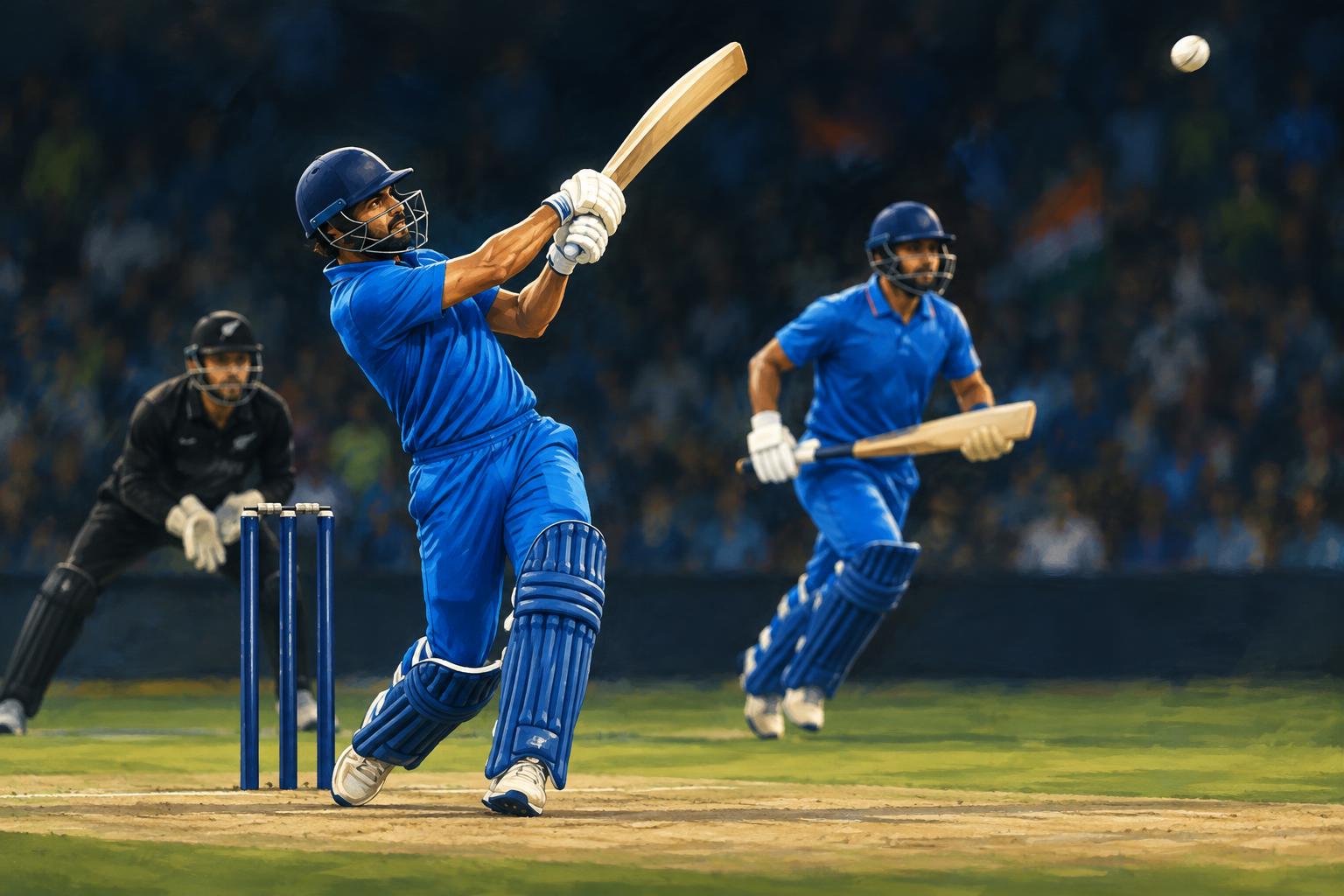
Abhishek Sharma made a demanding target look manageable for India at Wellington’s Sky Stadium. His 113 from 38 balls against New Zealand was the match’s highest individual score and its only century. The significance lay as much in its timing as its size: he had completed his contribution before the chase reached its halfway point.
An opening stand that changed the pursuit
Abhishek began with 199 required. The hosts had posted 198/3, built around Daryl Mitchell’s unbeaten 89 from 52 deliveries. That gave the pursuit a substantial starting requirement, but India’s opening pair prevented New Zealand from defending it with early wickets.
The defining partnership was 133 for the first wicket with Vaibhav Sooryavanshi. It was the largest stand of the match and accounted for 67% of India’s eventual total. Rather than leaving the middle order to accelerate later, the openers did the decisive work together, establishing control before New Zealand could separate them.
Sooryavanshi’s contribution mattered in its own right. He struck 45 from 19 balls, including four fours and four sixes, ensuring the partnership was not simply a platform maintained at one end while Abhishek attacked from the other. Matthew Fisher eventually had him caught by Mitchell at 7.1 overs, but the breakthrough came after the stand had already reshaped the chase.
Abhishek’s own boundary count explained the scale of the pressure: nine fours and 11 sixes, delivered at a strike rate of 297.4. His innings supplied 57% of India’s runs. Those figures, available in the match scorecard, captured both the speed of his scoring and how much of the pursuit he took upon himself.
The opening wicket did not end his influence. With Sanju Samson, Abhishek added another 45 for the second wicket, extending the advantage rather than leaving a rebuilding job. Kyle Jamieson dismissed him to a catch by Glenn Phillips from the final delivery of the 10th over, with India at 178/2. By then, the century had served its purpose even though its maker would not finish the chase.
New Zealand still found wickets, and Mitchell Santner’s return of 1/17 from three overs provided a contrasting measure of control. Yet those interventions could not undo the opening partnership or Abhishek’s continuation after it. India reached 199/4 in 13.2 overs, winning by six wickets with 40 balls remaining.
The broader match is covered in the full match report, but the central contribution was clear: Abhishek combined the innings’ greatest individual weight with its most productive partnership. India lead the five-match series 3–0 with two matches remaining and have won the series.