The preliminary round of the ICC Men’s T20 World Cup 2026 has drawn to a dramatic close, filtering twenty nations down to the final eight. This edition of the tournament, co-hosted by India and Sri Lanka, has already etched itself into history books with a mix of clinical brilliance from the powerhouses and a heartbreaking exit for one of the game's greatest giants, Australia.
As we move into the Super Eight stage, the pressure reaches a boiling point. Points from the opening round are wiped clean, and these eight teams must now navigate a fresh, high-stakes group format to determine the semi-finalists. In a departure from previous formats, the teams have been placed into two specific groups based on their tournament seedings and performance.
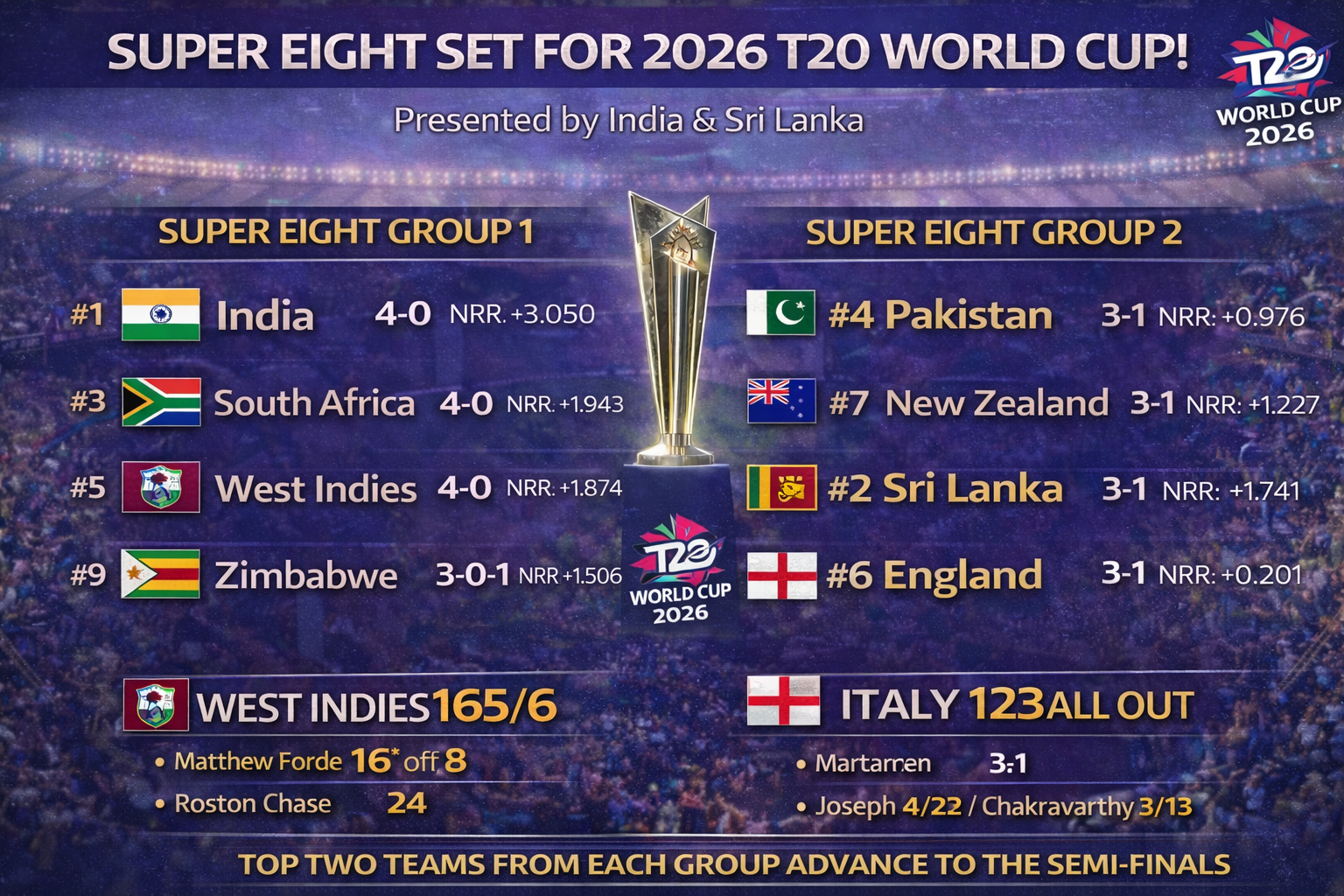
The Super Eight Group Structure
Instead of the traditional table, here is the breakdown of the two groups that will battle for a spot in the final four:
Super Eight Group 1
This group features a fascinating mix of undefeated heavyweights and a historic underdog. It consists of the world-ranked Number 1 India, a relentless South Africa, the explosive West Indies, and the tournament’s surprise package, Zimbabwe. Group 1 is expected to be a battle of attrition, with the matches spread across top-tier Indian venues like Ahmedabad, Chennai, and Mumbai.
Super Eight Group 2
Group 2 is a subcontinental dream, featuring three teams intimately familiar with the local conditions. It includes the resilient Pakistan, the tactical New Zealand, the co-hosts Sri Lanka, and the defending champions England. With three of the four teams hailing from the Asian circuit or having deep experience in these conditions, Group 2 promises some of the most technical and spin-dominant cricket of the year.
Group Stage Post-Mortem: How They Got Here
The road to the Super Eight was paved with dominant victories and nail-biting finishes. Each of the eight qualified teams brings a unique momentum into the next phase.
India: Group A Winners
India has been the undisputed gold standard of the tournament so far. Finishing the group stage with a flawless 4 wins and 0 losses record, the Men in Blue secured 8 points and an intimidating Net Run Rate of plus 2.500. Their campaign was highlighted by a clinical 61 run victory over arch-rivals Pakistan, where Ishan Kishan’s explosive 77 set the tone. Under the captaincy of Suryakumar Yadav, the Indian bowling unit led by Jasprit Bumrah and the mystery spin of Varun Chakravarthy, has looked virtually impenetrable.
South Africa: Group D Winners
Often labeled as underachievers in ICC events, the 2026 Proteas have looked like a team on a mission. They finished Group D with 4 wins from 4 matches, tallying 8 points and a strong Net Run Rate of plus 1.943. Their campaign was a testament to squad depth; even when rotating players against the UAE, the team secured a comfortable six-wicket win. With youngsters like Dewald Brevis finding form alongside veterans like Quinton de Kock, South Africa enters Group 1 as a major threat.
West Indies: Group C Winners
The Men in Maroon have brought the carnival to the World Cup, finishing their group stage with 4 wins and a spotless 8 points. Their Net Run Rate stands at plus 1.874. Captain Shai Hope has been the anchor, scoring a vital 75 in their final group game against Italy. What makes the Windies particularly dangerous in the Super Eight is their balanced attack; Shamar Joseph’s raw pace combined with the left-arm wizardry of Gudakesh Motie has seen them bowl out opponents in three of their four matches.
Zimbabwe: Group B Winners
The story of the tournament is undoubtedly Zimbabwe. After the heartbreak of missing the 2024 edition, they topped Group B with 3 wins and 1 no-result, finishing with 7 points and a Net Run Rate of plus 1.506. Their defining moment came in a historic victory over Sri Lanka in Colombo, where they chased down 179 with surgical precision. By finishing above the co-hosts and knocking out Australia, Zimbabwe has proved they belong among the elite.
Pakistan: Group A Runners-up
Pakistan’s journey was a rollercoaster of emotions. After a devastating loss to India and a scare against the United States, they found their cornered tigers spirit just in time. They finished with 3 wins and 1 loss for 6 points and a healthy Net Run Rate of plus 0.976. The catalyst for their qualification was Sahibzada Farhan, who smashed a brilliant unbeaten century against Namibia in their final game. With the mystery of Usman Tariq and the return of a fresh Shaheen Afridi, Pakistan is hitting their peak at exactly the right moment.
Sri Lanka: Group B Runners-up
The co-hosts enjoyed a strong start but suffered a late reality check against Zimbabwe. Nevertheless, they finished with 3 wins and 1 loss for 6 points and a robust Net Run Rate of plus 1.741. Pathum Nissanka has been their standout performer, recently becoming a centurion against Australia. Playing the majority of their Super Eight games in familiar Pallekele and Colombo venues, the Lions remain a dark horse for the title.
New Zealand: Group D Runners-up
Clinical, professional, and consistent the Black Caps avoided the group-stage exit of previous years by securing 3 wins from 4 matches for 6 points with a Net Run Rate of plus 1.227. Their qualification was sealed by an 8-wicket thrashing of Canada, where Glenn Phillips smashed a fast fifty. Mitchell Santner’s leadership and the form of Rachin Ravindra make them a tactical nightmare for any opponent in Group 2.
England: Group C Runners-up
The defending champions took the long road to the Super Eight. After an early loss to the West Indies, they had to fight through tight contests against Scotland and Italy. They finished with 3 wins and 1 loss for 6 points and a Net Run Rate of plus 0.201. While captain Jos Buttler has looked for individual runs, the middle order led by Harry Brook has remained resilient. England’s experience in knockout-style cricket remains their greatest asset.
The Road Ahead
The Super Eight stage officially kicks off on February 21, 2026, with a high-voltage encounter between Pakistan and New Zealand in Colombo. This phase is not just about survival; it is about positioning. The top two teams from each group will advance to the semi-finals in Mumbai and Kolkata, with the grand final scheduled for the Narendra Modi Stadium in Ahmedabad on March 8.
With the big boys like Australia already watching from the sidelines, the message is clear: in 2026, reputation means nothing and performance is everything.